Practically · Money
How do you pay in Colombia, and how do you open an account?
Cash is taken everywhere, cards only in big shops, and the rest of the country pays by instant transfer through a key or a QR code in Bre-B, the system that has connected banks and wallets since 2025. A foreigner gets into it only with a Colombian account or with Nequi or Daviplata. Always pay in pesos, withdraw in large amounts, and ask for the 4x1000 exemption as soon as the account is open.
Checked 31 August 2026
There are three ways to pay in Colombia, and each has its own rules, its own fees and its own places where it does not work.
Cash is taken by everybody. Cards only in some places. And then there is a third way with no European equivalent, which over the past year has taken over small payments: instant transfers by key or QR code. Arrive with only a card and your first week will feel like another century; then you realise it is the other way round.
Cash still leads, but not where you would expect
Cards work in large supermarkets, shopping centres and at most petrol stations. In a small shop, a local restaurant, at the market, in a tuk tuk or with a tradesman, assume the card will not work.
A few practical things about Colombian cash:
- Notes are 2, 5, 10, 20, 50 and 100 thousand pesos; coins 50, 100, 200, 500 and 1,000.
- The hundred thousand note is a problem. You cannot pay with it in a bakery and nobody will change it for you. The word you need is sencillo, small change, and locals hunt for it too.
- Break notes in big shops with a proper till, and save the small stuff for markets and transport.
- Counterfeits exist, mostly fifties and hundreds. Cashiers hold them up to the light as a matter of routine; it is not distrust of you.
- Do not count money in the street. Pulling out a wad on the pavement is exactly what nobody does in Medellín.
How much to carry
Two wallets. One holds what you will spend today, fifty to a hundred thousand pesos in small notes, and that is the one you take out. The other holds the card and the reserve and stays where it is.
Carrying everything in one and pulling that one out at a stall is precisely what is called giving papaya here.
Cards: where they work and how not to lose on them
Your European card works in Colombia, but the outcome rests on three things, two of which you control.
Always pay in pesos. When the terminal or the cash machine asks whether you want to pay in euros or your home currency, say no. That conversion is known as DCC and the rate is set at that moment by the party asking. The gap is commonly three to seven per cent and all of it against you.
Your own bank's fees. Your bank charges for payments and for withdrawals, and on ordinary European cards that is not negligible. A card with no foreign currency fee is worth arranging before you fly.
Tell your bank you are travelling. Plenty of banks block South American transactions as suspicious. Either notify them in advance or expect a phone call in the middle of your shopping.
Cash machines: where to withdraw and what it costs
Withdraw inside a bank or in a shopping centre, not from a machine on the street. It is not only about money: a pavement ATM is a classic place for foreigners to get robbed.
- The machine's fee appears on screen before you confirm. If you do not like it, cancel and try another bank; the differences between networks are noticeable.
- Withdraw larger amounts at once. The fee is fixed, so five small withdrawals cost five times what one large one does.
- The per withdrawal limit tends to sit between a few hundred thousand and two million pesos depending on the bank and your card.
- And mind the same question as at the till: "in your own currency?" means a worse rate. Always pesos.
The question nobody from Europe expects
When you pay by card in a Colombian shop, the assistant asks: "¿cuántas cuotas?", how many instalments.
Colombians routinely pay by credit card over three, six or twelve months, with the bank adding interest. On a debit card the question makes no sense, and on a foreign card it makes none either.
The answer is "una", one instalment. Say a higher number and you land in a repayment scheme you did not want; on a foreign card it usually just ends in a declined transaction.
Rent, bills and PSE
Bills for electricity, water, gas and internet arrive monthly as a recibo, a payment slip with a barcode. There are three ways to pay it:
- at a bank branch or in a shop (Éxito, chemists, small offices such as Efecty), handing over the slip and paying cash,
- from your account through PSE, the Colombian standard for paying online from a bank account: pick your bank, log in, confirm,
- by direct debit, arranged with the provider and by far the easiest once you are staying.
Rent in Colombia is normally paid by transfer or through Bre-B, not in cash. Ask for a receipt for every payment; paper proving you paid matters more here than a European expects.
The receipt not to throw away
Colombia runs electronic invoicing and businesses commonly issue a factura electrónica. Anyone dealing with taxes, expenses or VAT refunds here needs it in their own name and with an identification number, not just a till receipt.
A tourist may be able to reclaim VAT on certain goods when leaving, but only for selected categories and with documents in their name. Worth trying on larger purchases, not on coffee.
Bre-B: the thing Europe does not have
This is the biggest change of recent years and it needs explaining, because almost all small commerce now leans on it.
Bre-B is the unified instant payment system run by Colombia's central bank, interoperable across banks and wallets since 2025. More than thirty institutions take part, among them Bancolombia, Davivienda, Nequi and Daviplata.
It works on keys (llaves). A key is whatever the system finds you by: a phone number, an ID document, an email address or a generated code. One person can hold up to four keys and registration is free.
In practice:
- You do not pay to an account number, you pay to a key or by scanning a QR code.
- The money arrives instantly, across different banks, weekends included.
- No card terminal is needed. Which is why a fruit stall takes it.
For a foreigner that yields one thing, and it matters: without a Colombian account or wallet you cannot enter this world at all. Two weeks here and cash plus a card is fine. Months here and you want an account or a wallet, because otherwise you are paying in cash for things locals settle on a phone in three seconds.
Nequi and Daviplata: the wallets everybody has
Nequi belongs to Bancolombia, Daviplata to Davivienda, and both are apps tied to a phone number. They open in minutes, carry lower limits and do exactly what a European uses cash for: splitting a bill, sending a few thousand, paying for lunch, topping up credit.
Worth knowing:
- The basic tier has low caps on balance and monthly turnover. More than that requires full identity verification.
- A foreigner usually opens one with a cédula de extranjería. With a passport it is sometimes possible, at a branch rather than in the app.
- They are connected to Bre-B, so from a wallet you can pay somebody at any other bank.
A bank account: what will be asked of you
An account at a major bank (Bancolombia, Davivienda, Banco de Bogotá) is a different league from a wallet: rent can be paid from it, income arrives into it, and it shows up in a visa application.
What you generally need:
- a cédula de extranjería, the residence document, not just a passport,
- proof of income or of the source of funds,
- proof of address (a utility bill, a lease),
- patience: opening happens at a branch, on paper, over two visits.
There are digital banks where it is quicker and easier, but with them you may find that some companies cannot send you money or set up a direct debit. For the first year it is reasonable to have both: a big bank for contracts and a wallet for ordinary life.
The four per thousand nobody mentions
Colombia has a financial transactions tax known as the 4x1000. Every withdrawal, outgoing transfer or payment from an account is charged four per thousand of the amount. On a million pesos that is four thousand, which looks like nothing until it adds up over a year.
The exemption is the important part:
- Every individual has 350 UVT exempt per month. The UVT is a tax unit, set at 52,374 pesos for 2026, so the exempt ceiling works out at roughly 18.3 million pesos a month.
- But the account has to be flagged as exempt. It is not automatic, you request it at the bank, and it is one of the first things to do after opening.
- From 2026 the exemption is counted per person rather than per account, so movements across banks are added together.
For an ordinary person this means the tax practically never applies. For somebody moving larger sums it means doing the arithmetic.
Money in and out of Europe
A transfer through a service like Wise almost always beats a SWIFT bank transfer, and beats withdrawing cash in small amounts by a mile. You send euros, it arrives in pesos in a Colombian account, and you see the rate up front.
Things to watch:
- Currency risk. The peso moves by several per cent in a week. If your income is in euros and your spending in pesos, do not hold a large balance in one currency purely out of inertia.
- Invoicing clients. Working for European clients from Colombia is ordinary, but tax residence changes after 183 days of presence, and from that point it is a different exercise. I write about it in the visa guide; here I will only say that it cannot be solved by not thinking about it.
- Cash across the border. Declarable from ten thousand dollars or the equivalent. It is not a ban, it is a form.
Exchange rates and where to change money
Change nothing at the airport beyond the fare for a taxi. The rate there is the worst you will meet in the country.
In the city you change money at casas de cambio in shopping centres, where rates are displayed and can be compared. Dollars get a better rate than most European currencies, which are exotic here and often refused.
In practice the simplest approach is: withdraw large amounts from a cash machine, pay by card where cards work, and change physical currency only as an exception.
The first forty eight hours
- Withdraw only a little at the airport, a hundred or two hundred thousand pesos for transport and the first day. The rate and the fees there are the worst you will meet.
- Withdraw a proper amount in the city, from a machine inside a bank or in a shopping centre.
- Get small notes with your first purchase: buy something for twenty thousand with a large note in a supermarket, not in a bakery.
- Turn on transaction alerts in your home banking app and check the card works before you need it.
- Leave the wallet app and the bank account until you have a cédula. Cash and a card are enough until then.
Five mistakes that cost money
- Paying or withdrawing in your own currency. Three to seven per cent gone, every time.
- Small withdrawals. A fixed fee paid five times instead of once.
- Not asking for the 4x1000 exemption. Four per thousand of everything passing through the account, for nothing.
- Carrying everything in cash. Not only because of theft: cash is genuinely less usable in Medellín than a key on a phone.
- Relying on a card outside big shops. You end up with somebody else paying for your lunch and you sending it back through Nequi. Which is, incidentally, the exact moment you understand how payments work here.
How to read the numbers in this guide
The UVT and the exemption ceiling apply to 2026 and change every January. The Bre-B rules come from the central bank's documentation. Bank and ATM fees change constantly and depend on your card, so treat them as an order of magnitude, not a price list.
What is first hand is written as my own experience. Verify the rest before a larger transaction.
What it costs
All prices- Arroz sofrito with prawns per a set lunch68 000 COPabout 21 USD10 September
- Grilled tilapia per a set lunch56 000 COPabout 18 USD10 September
- Ginger lemonade per a glass9 000 COPabout 3 USD10 September
- Agraz per a 250 g punnet15 900 COPabout 5 USD10 September
- Gold pineapple per 500 g3 100 COPabout 1 USD10 September
- Hass avocado per 500 g5 750 COPabout 2 USD10 September
- Large avocado per a piece6 400 COPabout 2 USD10 September
- Bacardí Añejo per a 700 ml bottle67 200 COPabout 21 USD10 September
- Bananas per 500 g1 740 COPabout 1 USD10 September
- Blueberries per a 125 g punnet7 760 COPabout 2 USD10 September
- Potatoes (papa capira) per 500 g2 210 COPabout 1 USD10 September
- Broccoli per 500 g4 420 COPabout 1 USD10 September
What I wrote about it
September
2026
17 entries
10 September · Article
Driving in Medellín: the day of the week your car stays home
The last digit of your number plate keeps the car off the streets one day a week, from five in the morning to eight in the evening, across the whole valley. Plus the licence that expires after six months, a fine over six hundred thousand pesos, and road death figures that make me uneasy.
10 September · Article · La Candelaria, Medellín
No water after eight in the evening. What is going on in Medellín
Three hundred thousand people in six communes have had water every other day since late August. The city broke its temperature records in May, Ideam expects a strong El Niño into March, and the grid operator warns that power may not stretch through December. What the rule says, why it landed on the hillsides, and what it means for a trip.
10 September · Article · La Casa del Alimento, Medellín
A lunch where the meat dries on a washing line
A Colombian lunch is not one dish, it is a whole set for one price. Two mains, two desserts, two coffees and a lemonade came to 146,000 pesos. And in that restaurant's yard, beef hangs drying.

10 September · Article · Conquistadores, Medellín
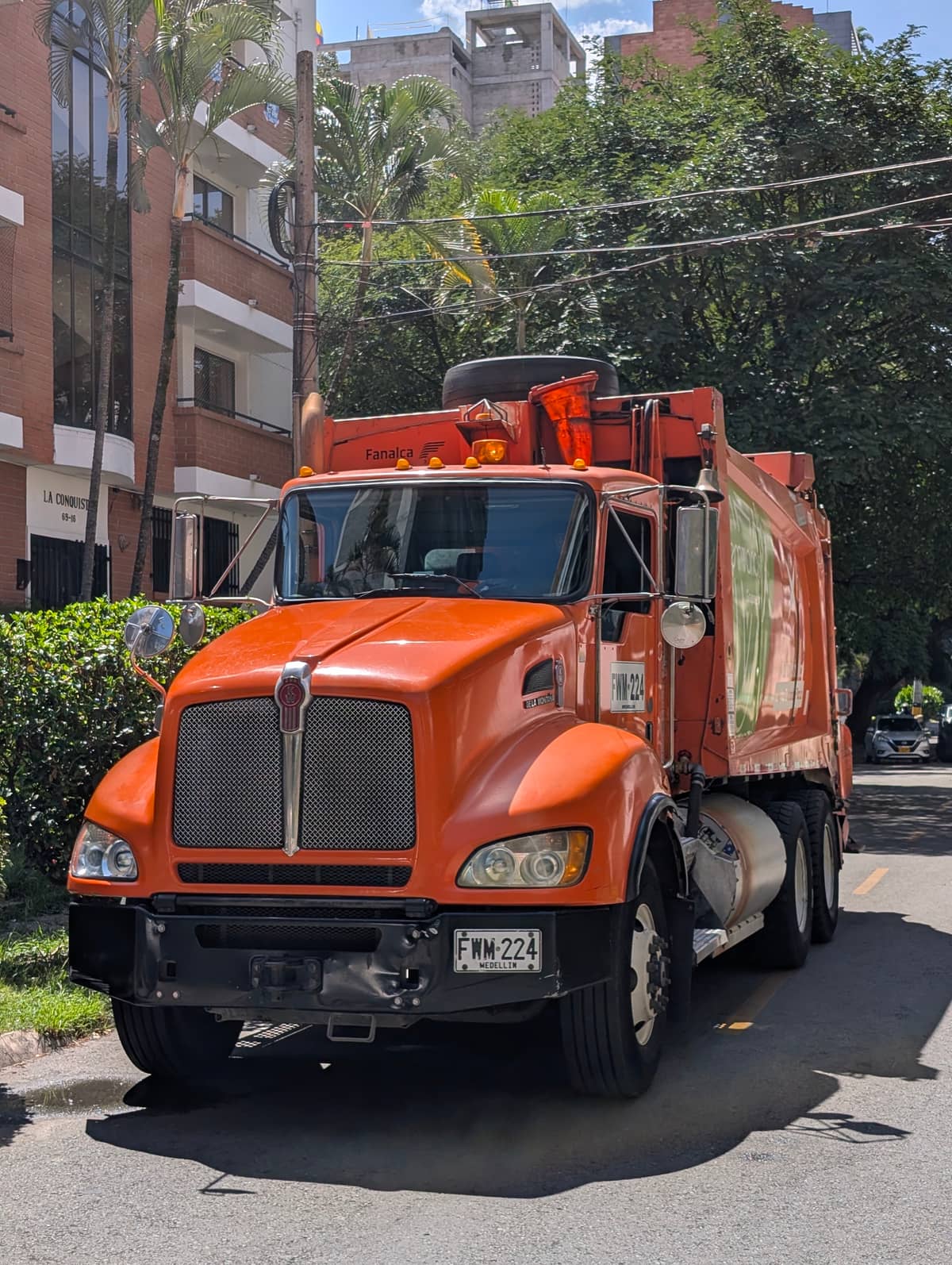
The bin men of Medellín
A garbage truck with a slogan saying this city is a little silver cup. Who runs it, where the waste goes, why the landfill has eight years left, and how the people who open bags on the street come to be paid out of the water bill.
10 September · Article · Comuna 8, Villa Hermosa, Medellín
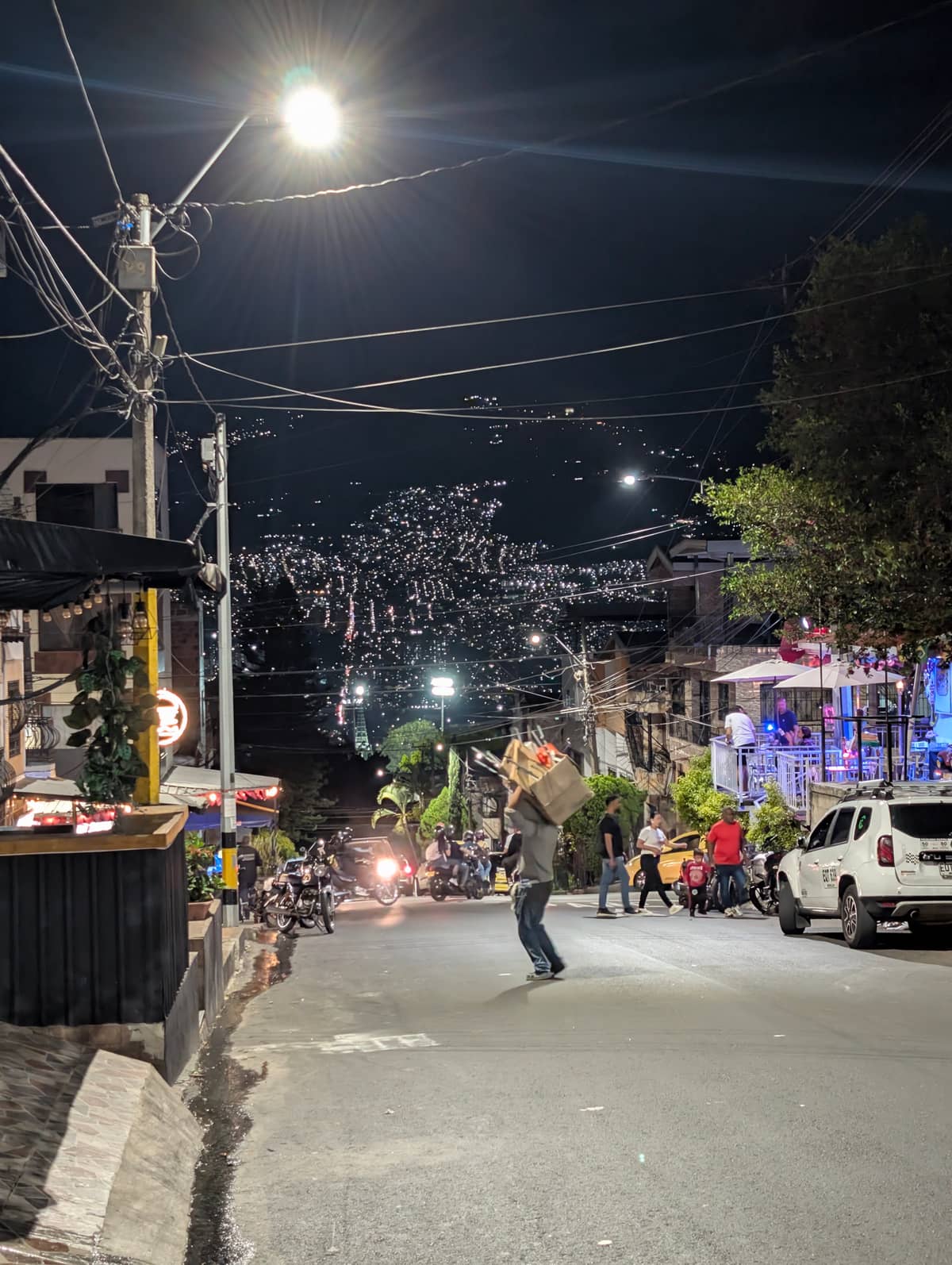
Villa Hermosa after dark
A house with almost no windows, hot rice pudding with cheese, and a slope full of lights right up to the ridge. And the only thing that made me uneasy was not what someone who has read about comuna 8 online would expect.
8 September · Article · El Poblado, Medellín
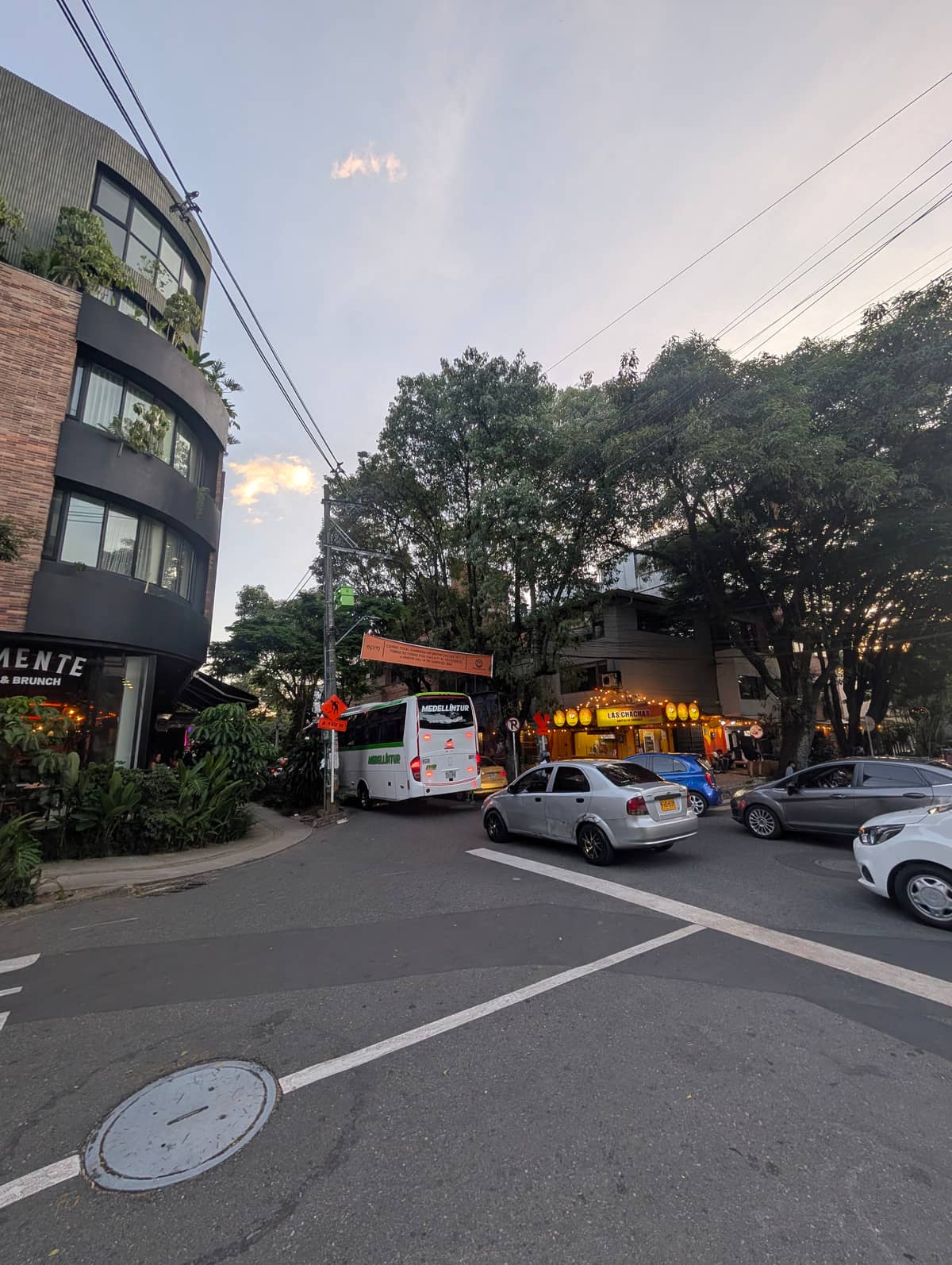
El Poblado after dark
The district where Medellín was founded in 1616 and where almost everybody who flies into the city now sleeps. Provenza with lights in the trees, the singer Karol G's restaurant, a road sign saying tourist zone, and a bill that sums it all up.
8 September · Note · La Candelaria, Medellín
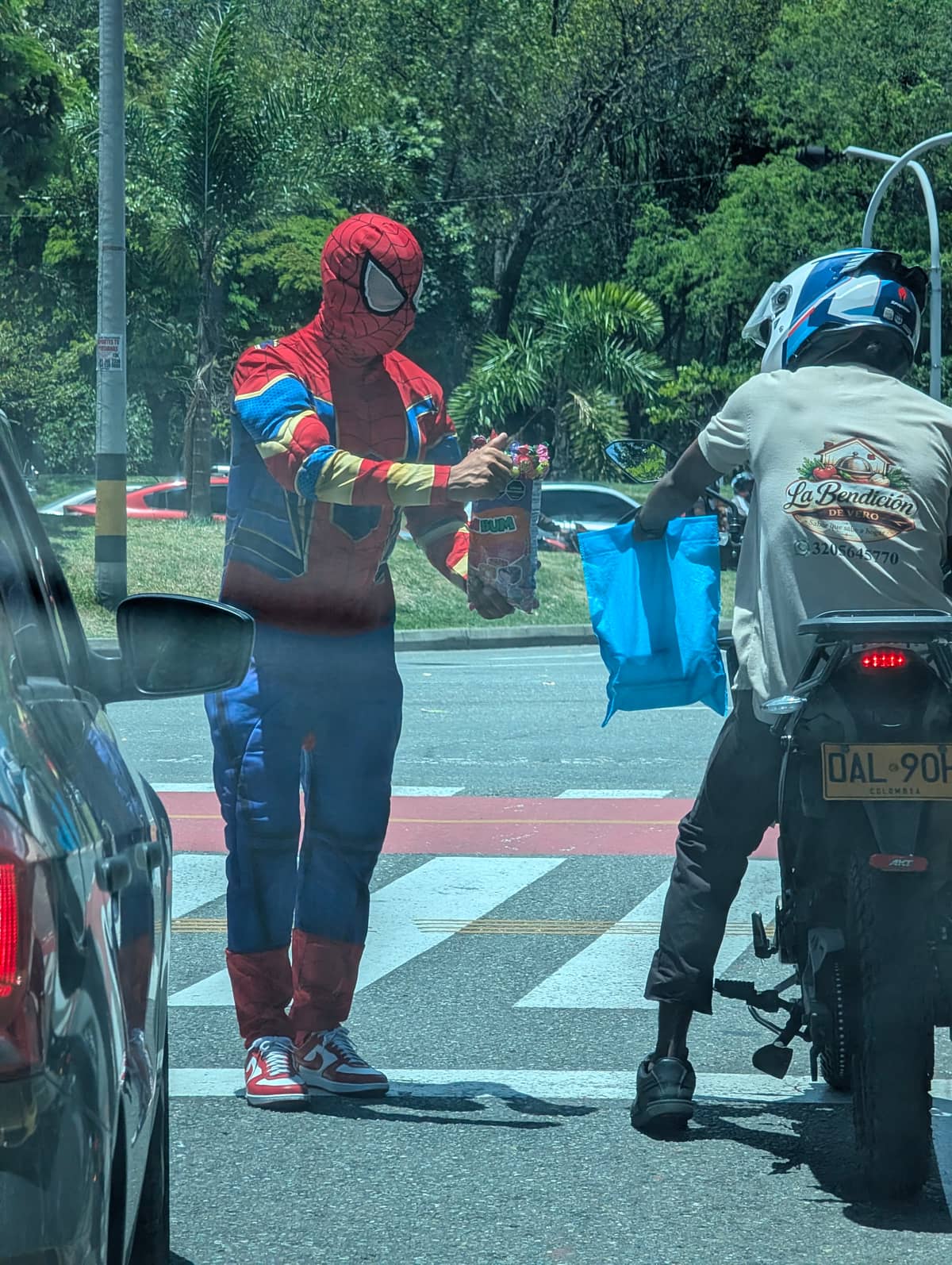
At a junction on Carrera 55, Spider-Man stands at a red light selling…
At a junction on Carrera 55, Spider-Man stands at a red light selling sweets between the cars. A motorbike rider behind him, a water stall beside him.
8 September · Note · Café Mattelsa, Medellín
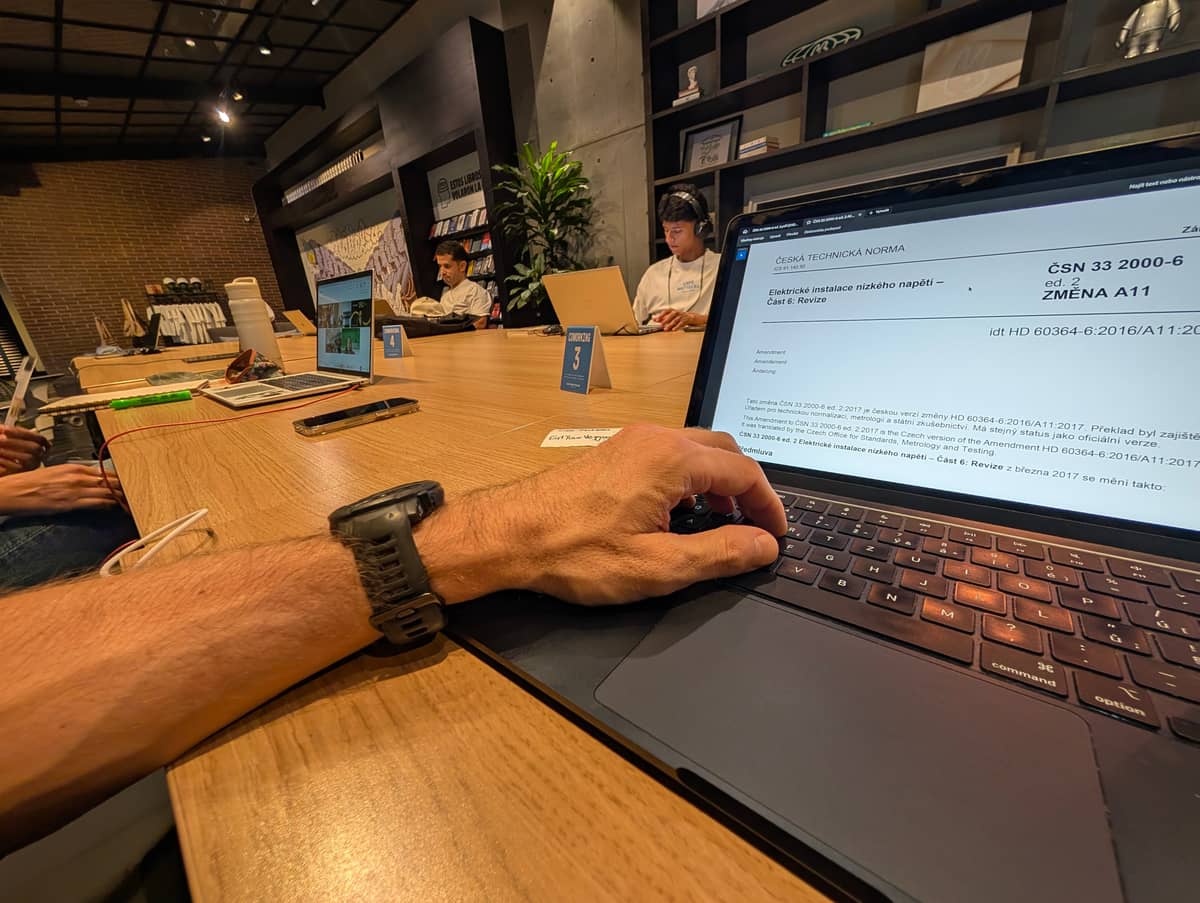
Café Mattelsa, two hours, one coffee and a kombucha. A Czech standard…
Café Mattelsa, two hours, one coffee and a kombucha. A Czech standard for electrical installations on the screen, a palm tree outside the window, people with laptops all around, and nobody making a…
7 September · Note
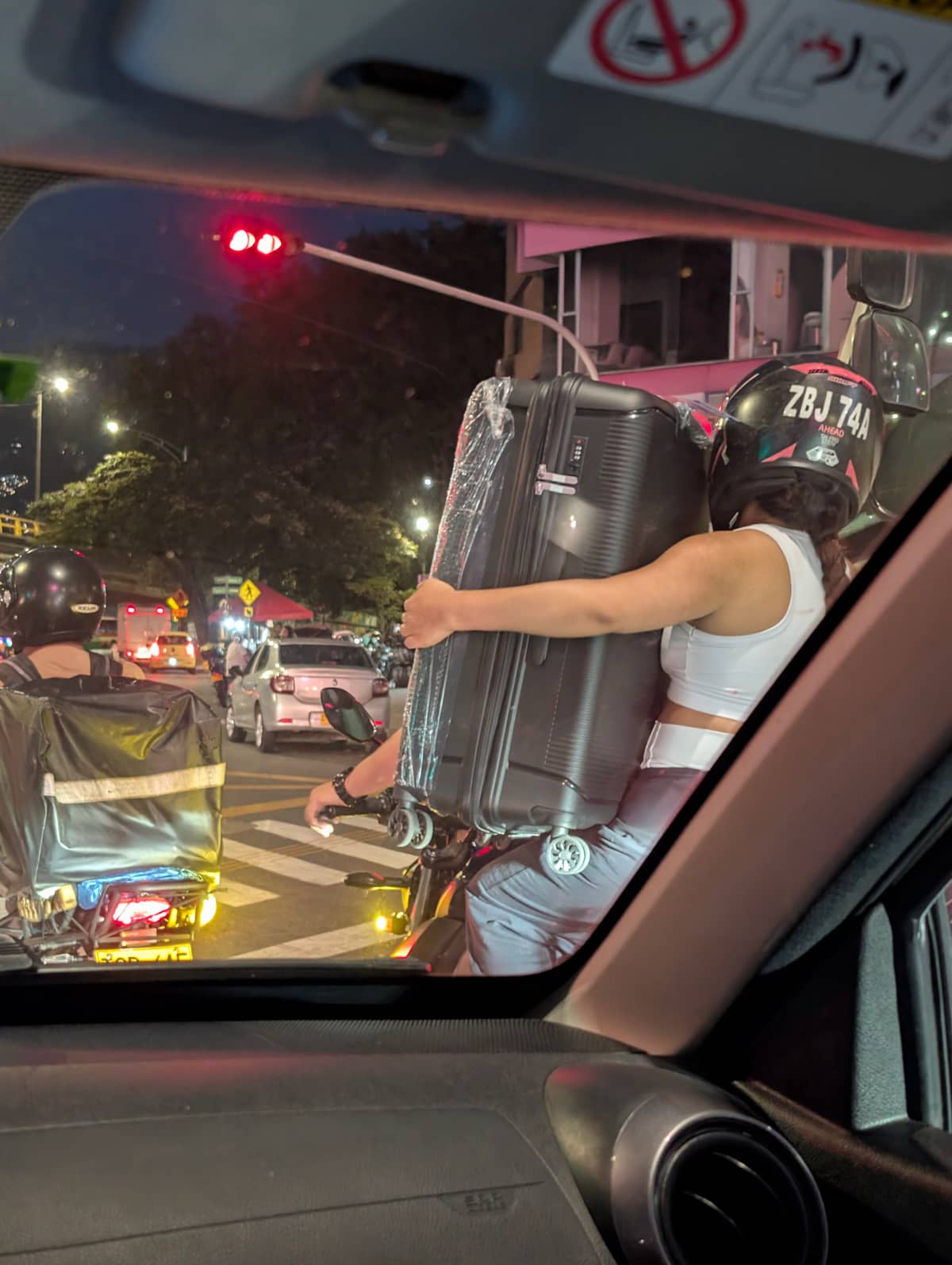
A pillion passenger on a motorbike carrying a large wheeled suitcase…
A pillion passenger on a motorbike carrying a large wheeled suitcase. One arm clamped around it, the other around the rider, knees against the tank, riding in traffic between the cars.
6 September · Article · Comuna 8, Villa Hermosa, Medellín
Up by cable car, down for an arepa
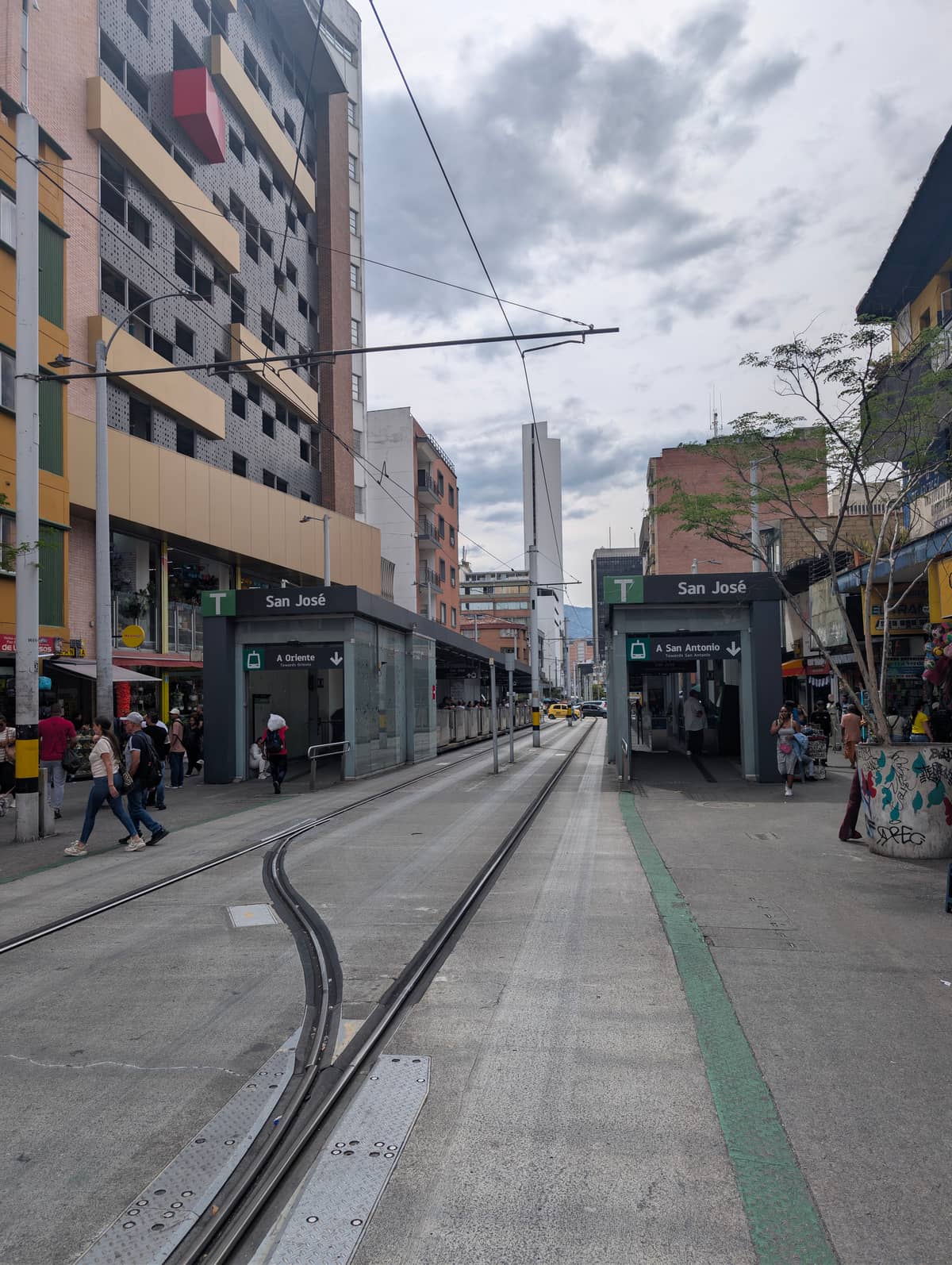
A tram on rubber tyres takes you from the centre to the edge of the city, and a cable car lifts you from there over the roofs of comuna 8. Back down there was an arepa festival, parakeets in a tree, a café in the house by the church, and a concert hall underground.
6 September · Article · La Candelaria, Medellín
El centro: the day I finally saw the city
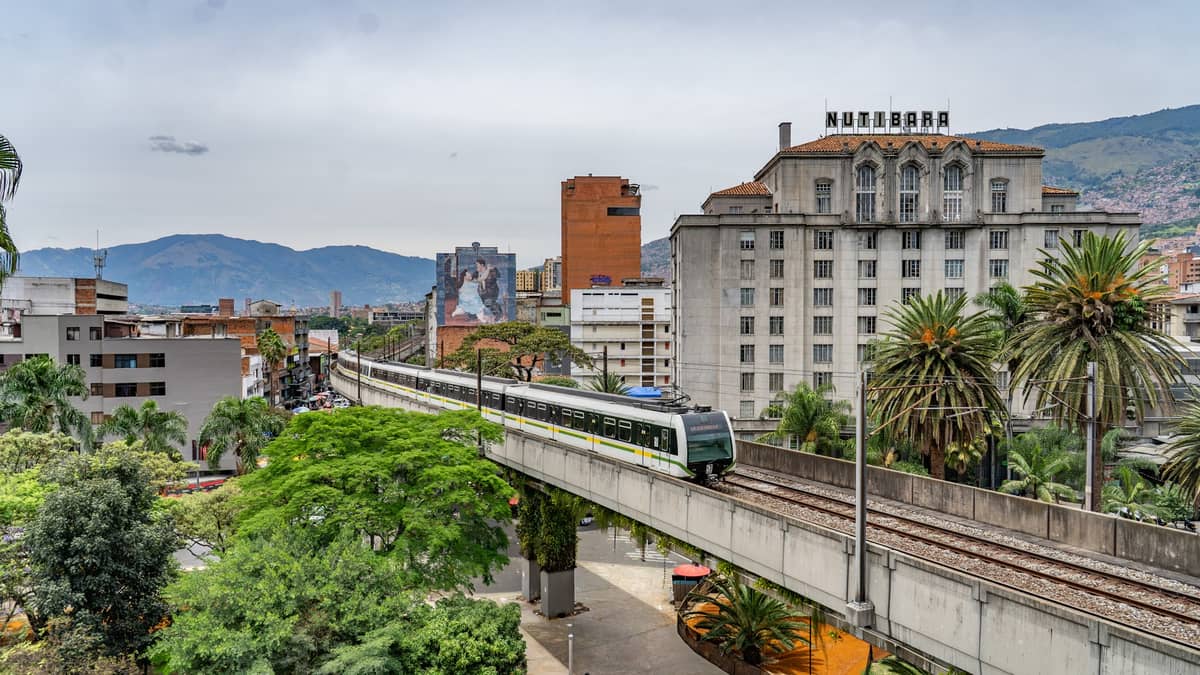
Every second person told me not to go into the centre of Medellín. I went by metro, cleaner than the one at home, and found a palace with a chequerboard facade, twenty three Botero sculptures, a cathedral made of a million bricks, and a market that has run since the seventies.
5 September · Note
The botanical garden was closed. Not for a holiday or repairs: they…
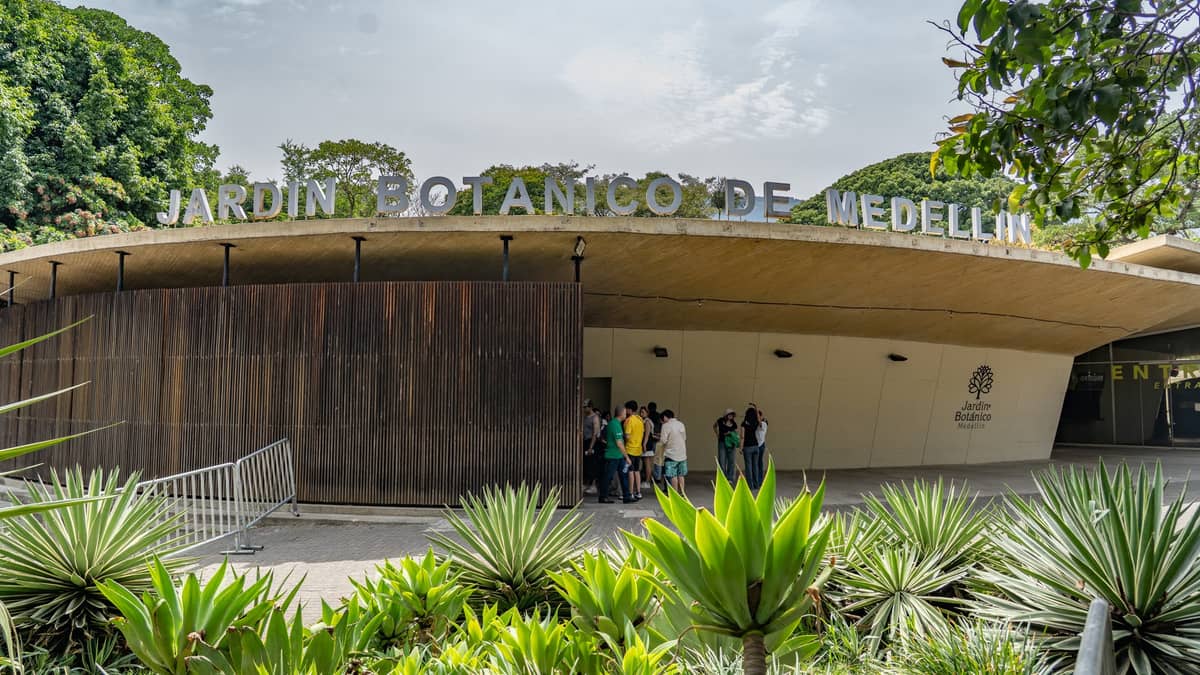
The botanical garden was closed. Not for a holiday or repairs: they are building the Fiesta del Libro y la Cultura inside it, the city's book festival, in its twentieth year and running from 11 to 20…
4 September · Article · Comuna 8, Villa Hermosa, Medellín
Villa Hermosa: lunch, a church and a market
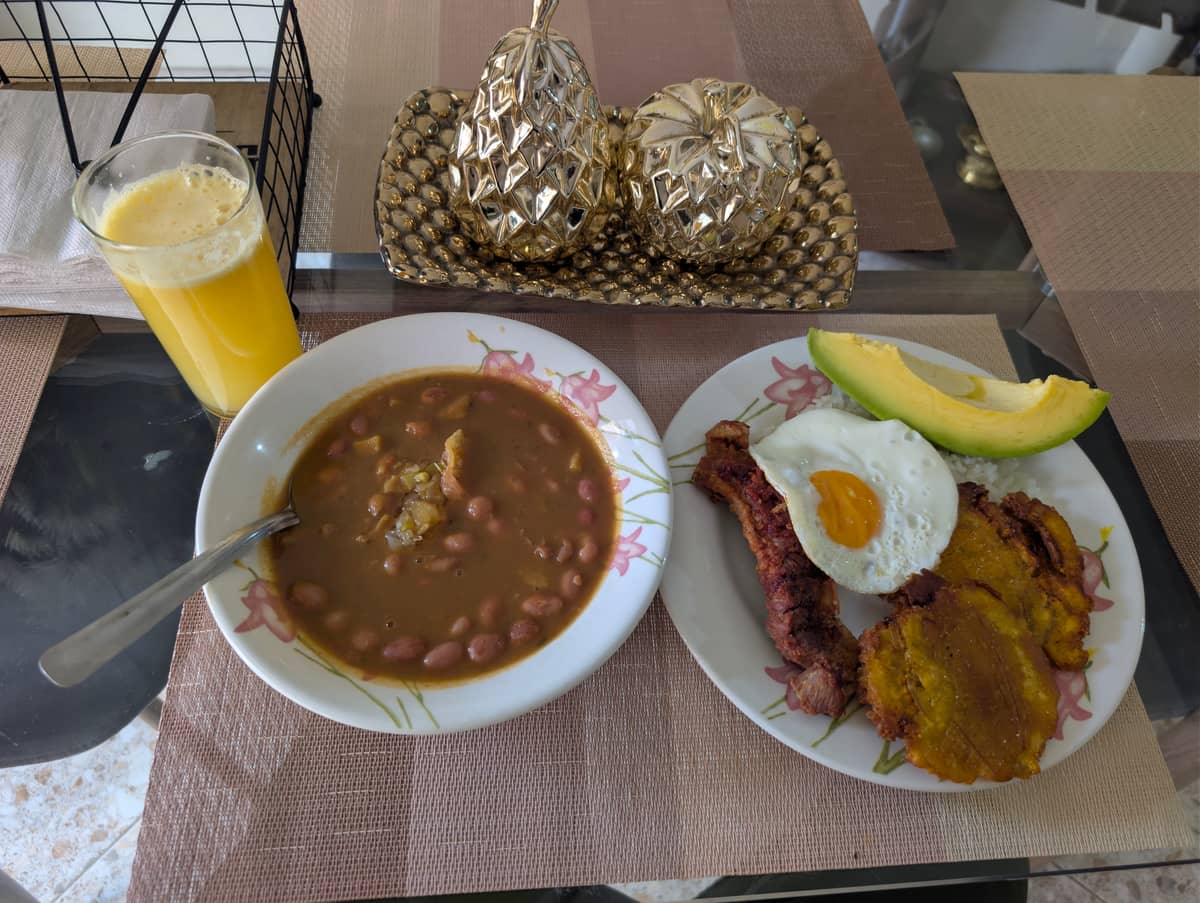
Comuna 8 up close, not from the cable car. A home cooked bandeja paisa with chicharrón, the brick church of La Sagrada Familia, stalls on the pavement, and traffic that runs on eye contact. On the way back, a stop among the villas of Prado.
3 September · Article · El Poblado, Medellín
A university as a park and a cinema in a mall
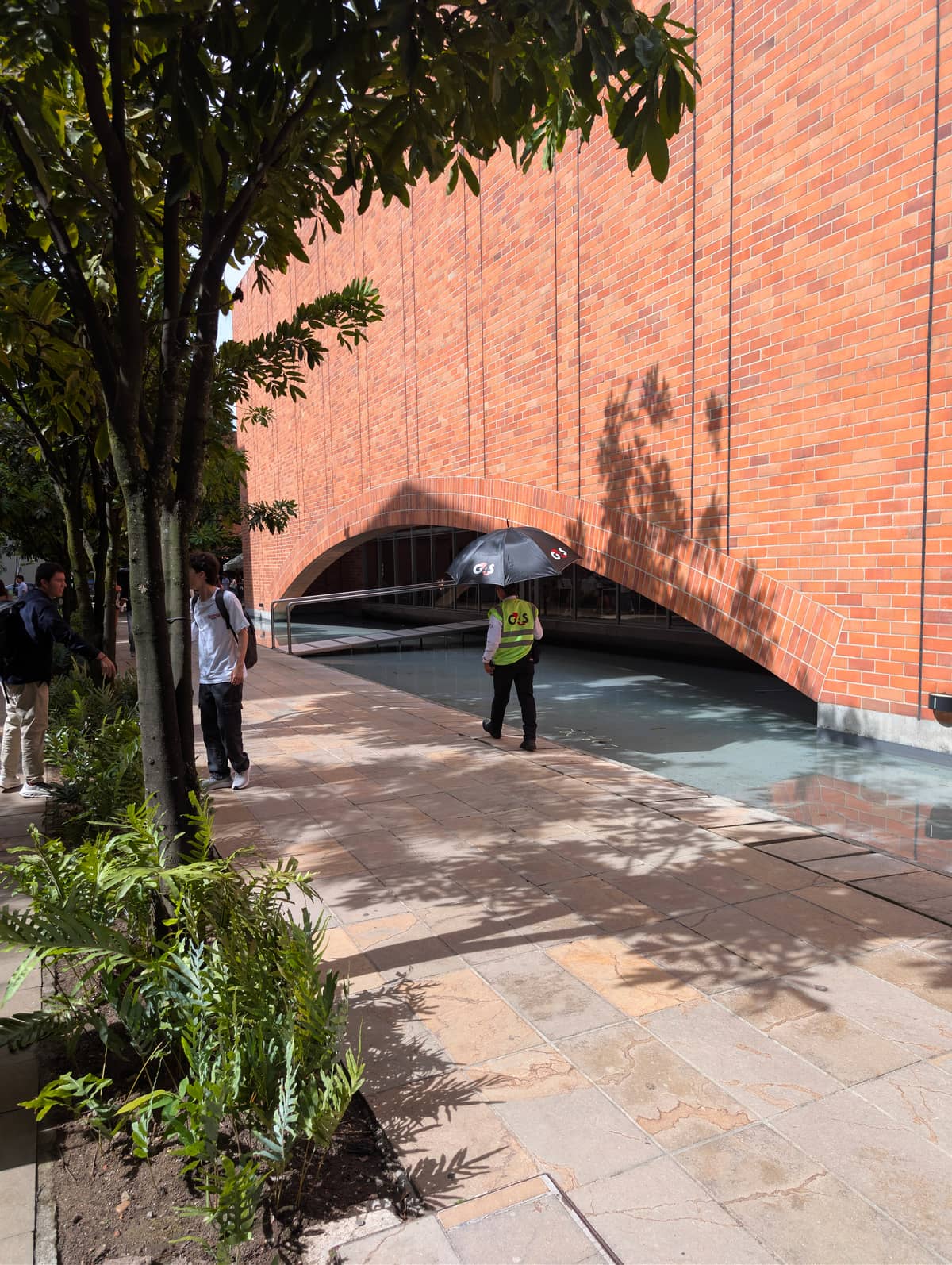
The EAFIT campus, which you can simply walk into, with mango trees, water along brick walls and birds in the middle of the city. And in the evening, the oldest mall in El Poblado, the first in Colombia to have its own cinema.
3 September · Article · El Poblado, Medellín
A dentist with a view
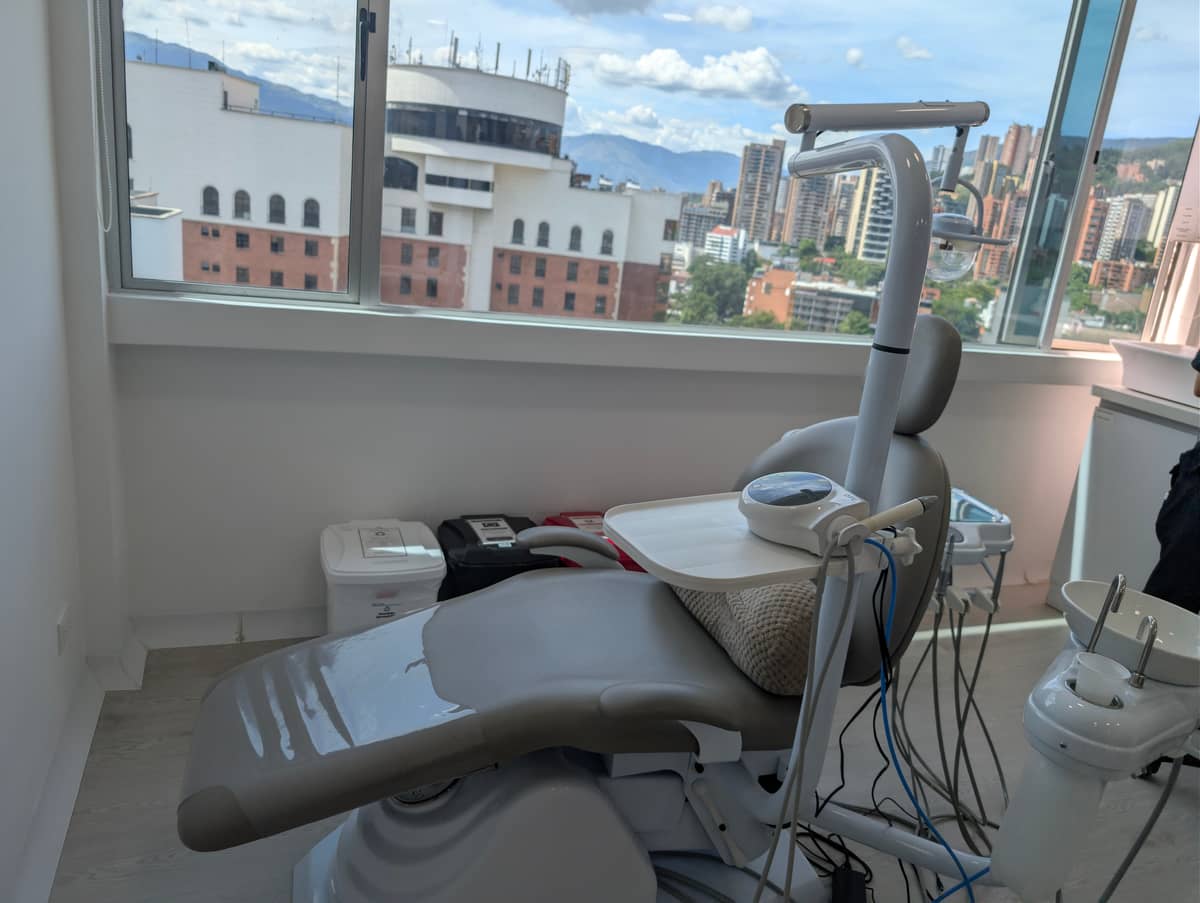
A tower full of consulting rooms in El Poblado, a restaurant on the ground floor, and a dentist's chair a metre from a glass wall with the whole Medellín valley behind it. What private care in Colombia looks like to a patient who arrived a month ago.
2 September · Note · Laureles, Medellín
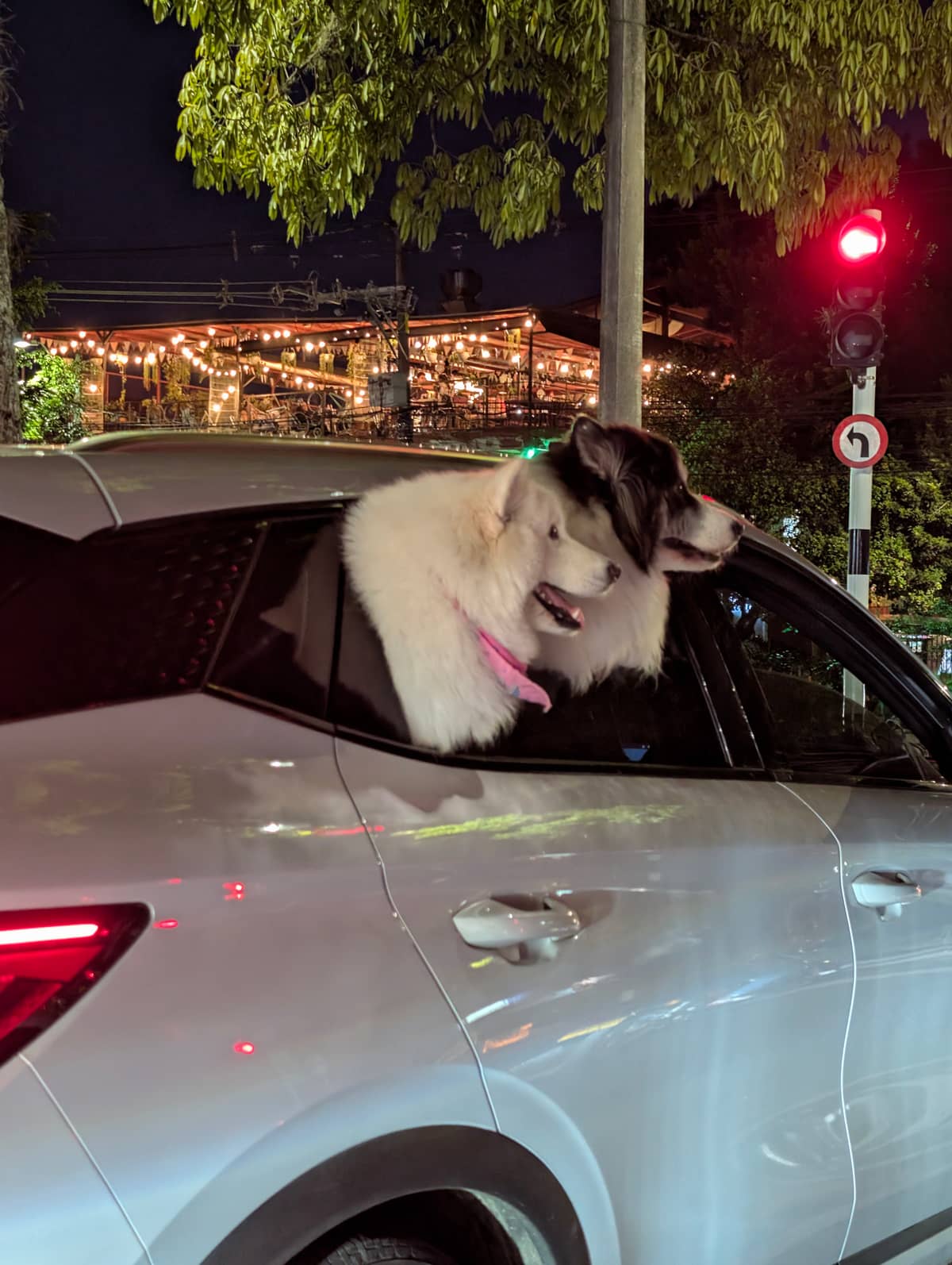
2 September · Article · Laureles, Medellín
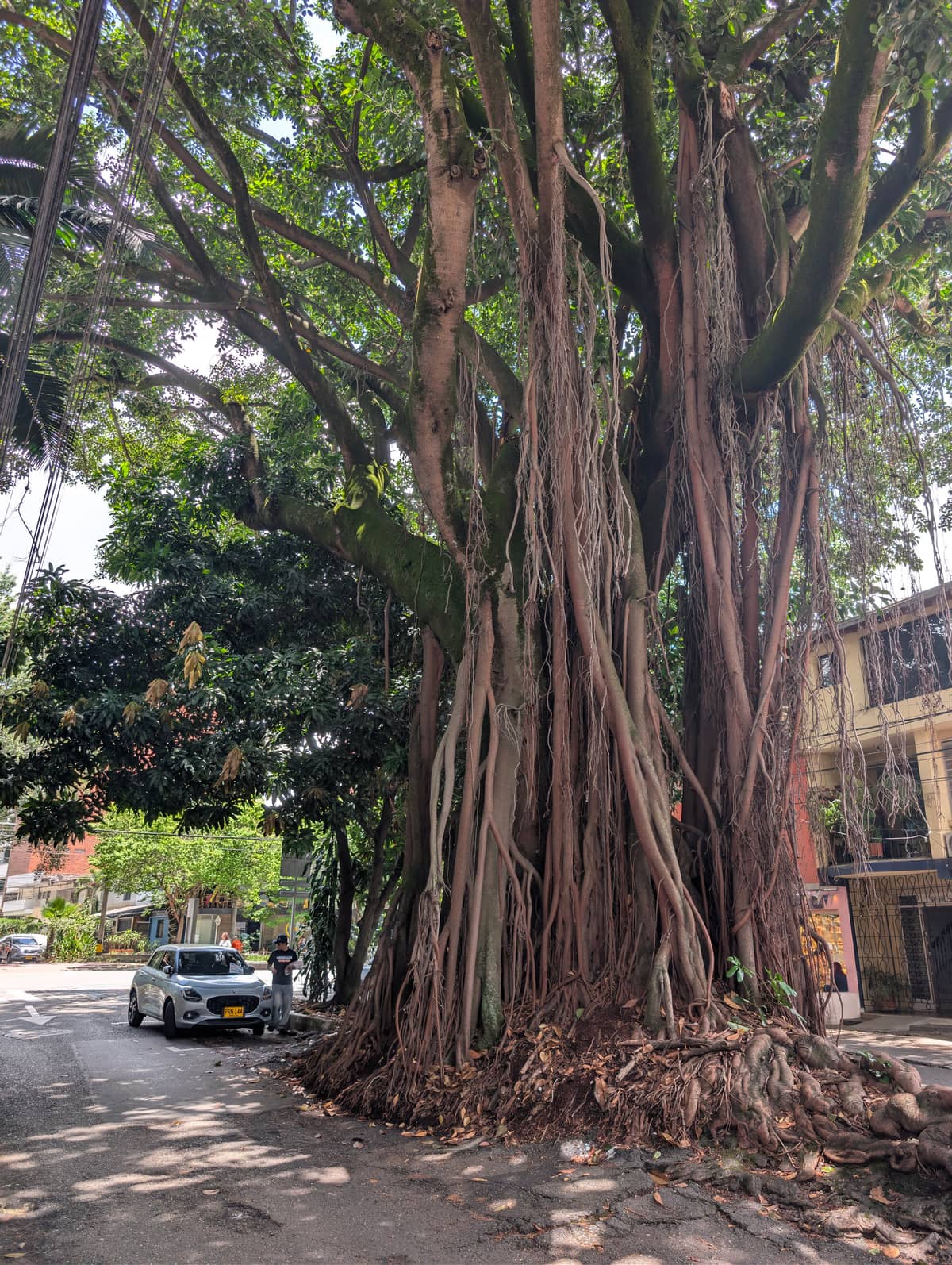
Laureles: a neighbourhood drawn in circles
A garden city from 1940 with circular streets, fig trees across the whole road, and cafés you can work from. The neighbourhood Medellín recommends to itself, and the one Time Out called the best in the world.
August
2026
1 entry
31 August · Article · Conquistadores, Medellín
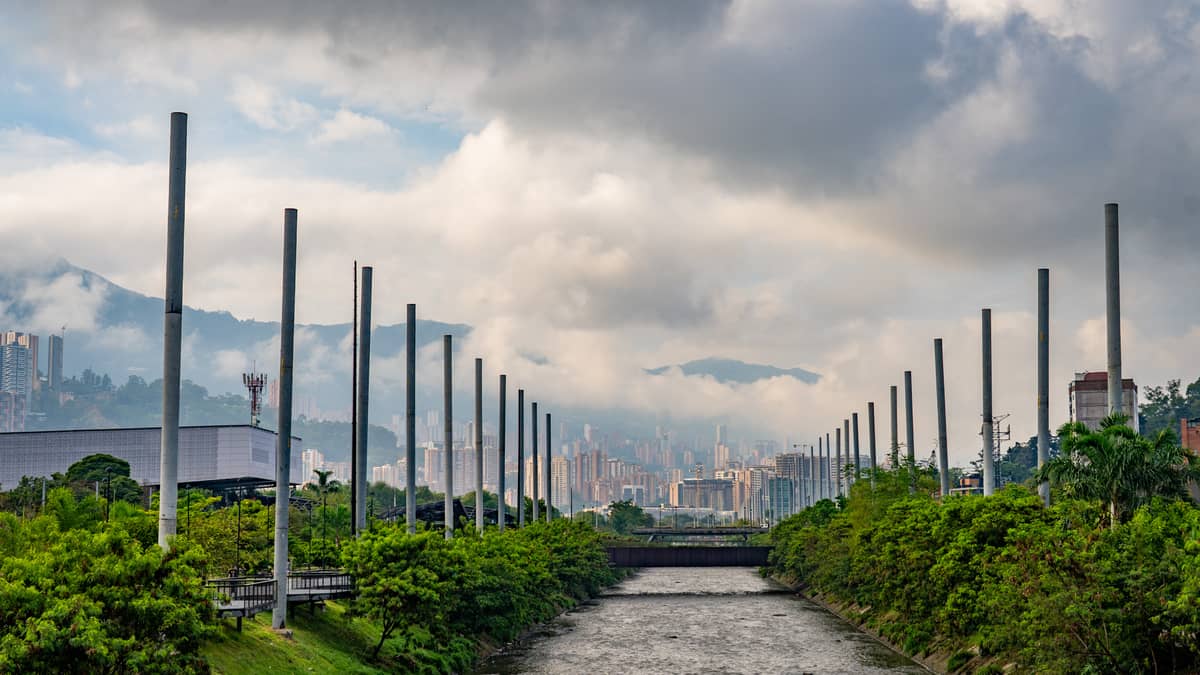
Where I live: Conquistadores
A neighbourhood between the river and Laureles that nobody writes about. Dogs on every corner and clean pavements, greenery that is not an accident, a bridge to the Barefoot Park, and seventies buildings among the palms.
Questions and answers
What do you want to ask?
Ask anything about this topic. I answer, and the answer stays here so the next person who wonders the same finds it.