Article · Practical · 10 September 2026
Driving in Medellín: the day of the week your car stays home
- Day of the journey
- 21
- Reading
- 9 minutes
The last digit of your number plate keeps the car off the streets one day a week, from five in the morning to eight in the evening, across the whole valley. Plus the licence that expires after six months, a fine over six hundred thousand pesos, and road death figures that make me uneasy.
Yes, it works the way you heard. Your car is banned from the streets one day a week, and the last digit of the number plate decides which day. It is called pico y placa, it runs from five in the morning to eight in the evening, and it covers not just Medellín but the whole Aburrá valley, ten municipalities.
It is the single rule that changes a driver's life here more than any other, and guidebooks barely mention it. This piece is about that rule and about everything else attached to driving: the licence that stops being valid after six months, the fines, how people actually drive here, and the numbers that make me uneasy as a safety professional.
The research is current to 10 September 2026. The rotation changes every six months, so the table below holds until the end of January 2027 and then becomes something else.

How pico y placa works
From Monday 3 August 2026 to 29 January 2027 the rotation is:
- Monday: 5 and 8
- Tuesday: 1 and 4
- Wednesday: 0 and 2
- Thursday: 3 and 6
- Friday: 7 and 9
The restriction runs Monday to Friday, continuously from five in the morning to eight in the evening. Not at peak hours, all day. It does not apply at weekends or on public holidays.
For cars the last digit of the plate decides. For motorbikes, including three wheelers and mopeds, the first digit does. That is the mistake people make most often: anyone with both a car and a bike is tracking two different digits in two different positions.
Taxis have their own regime, rotating every two weeks and running from six in the morning to eight in the evening. On the day you cannot drive, a share of the taxis cannot either, which is the less convenient half of it.
The rotation is reshuffled every semester. In the first half of 2026 it was Monday 1 and 7, Tuesday 0 and 3, Wednesday 4 and 6, Thursday 5 and 9, Friday 2 and 8. That is deliberate, so that one digit does not lose Monday forever. It also means whatever you learned stops being true in February and has to be written down again.
Where it applies and where it does not
It applies in Medellín and in nine other municipalities of the valley, which is effectively the whole metropolitan area. City limits are not the limits of the rule.
Some arteries are exempt, so you can use them on the day your digit is banned:
- the Sistema Vial del Río, the roads along both banks of the river
- part of Avenida Regional
- vía Las Palmas, the road up towards the airport
- the roads out to the corregimientos, the rural parts of the municipality
Watch out for Bello. It does enforce the restriction on the autopista Norte and on the Regional, even where neighbouring municipalities do not on the same roads. It is exactly the kind of exception to an exception that ends in a fine.
Electric, hybrid and gas vehicles are exempt, provided that is recorded in the national RUNT register. It is the only legal way out of the restriction, and you can see it on the streets: hybrids are multiplying here fast, and this is one of the reasons.
What forgetting costs
The fine is 633,111 pesos, and the vehicle can be towed on top of that. For the record, Colombian penalties are calculated in UVB units and this one is 52.29 of them, so it is revalued every year.
When the rotation started in August, the first four days were agreed as educational, warnings only. Fines began on 10 August.
There are plenty of cameras around the city and they work. This is not a rule you can survive by being careful.
Why it exists at all
The Aburrá valley is a narrow bowl between mountains and whatever is released into it stays there. Cars queue in it and the air has nowhere to go.
So alongside the ordinary pico y placa there is an environmental one. When air quality drops, the metropolitan authority can declare a contingency and tighten things: extend the restriction to weekends, add lorries and tipper trucks, change the hours. There are two critical windows, the main one from March to April and a second between October and November, both at the turn between dry and wet seasons.
Anyone coming in autumn or spring should expect the rule they looked up to be stricter a week later.
The licence: six months and then it stops
This is the part I had to work out for myself, and I could not find it written down anywhere in Czech.
A tourist may drive on their home licence, as long as it is valid and the stay does not exceed six months. That is article 25 of the national traffic code, law 769 of 2002. On a short trip there is nothing to arrange.
The moment you receive a cédula de extranjería, the identity document for foreigners with a visa longer than three months, you stop being a tourist. At that point your home licence stops being a valid driving document in Colombia, regardless of how many years you have driven or what your country has signed.
Only seven countries can have a licence recognised. Spain, Peru, South Korea, Chile, Paraguay, Argentina and Portugal. The Czech Republic is not among them and never has been, so for a Czech there is no exchange route at all. The whole Colombian process has to be done from scratch.
That process was itself rebuilt in 2026. The driving school used to teach you and then examine you. Now the two are split:
- CEA is the driving school and may only teach, theory and practice
- CALE is an independent testing centre and is the only body that may examine and certify
The logic is one we would recognise: whoever teaches should not be the one marking. In practice it means one more institution and several more appointments.
The prices to expect in 2026:
- a school course for a car, roughly 1,000,000 to 1,390,000 pesos; for a motorbike, 850,000 to 1,090,000
- the medical exam, 90,000 to 150,000
- the theory test, around 110,000
- the practical test, 512,000 to 582,000
- issuing the licence, 329,900
Someone with no previous experience ends up over two million pesos. Anyone who already knows how to drive and only needs the document pays less, but does not escape the tests.
And in case you were thinking of skipping it: driving without a valid licence is offence B01, eight daily minimum wages and the vehicle impounded.
How people actually drive
The signs and road markings are fine, both horizontal and vertical, and almost nobody follows them. Traffic runs on eye contact and on small movements of the vehicle: ask with an indicator and you get nothing, push your nose thirty centimetres forward and you get the gap.
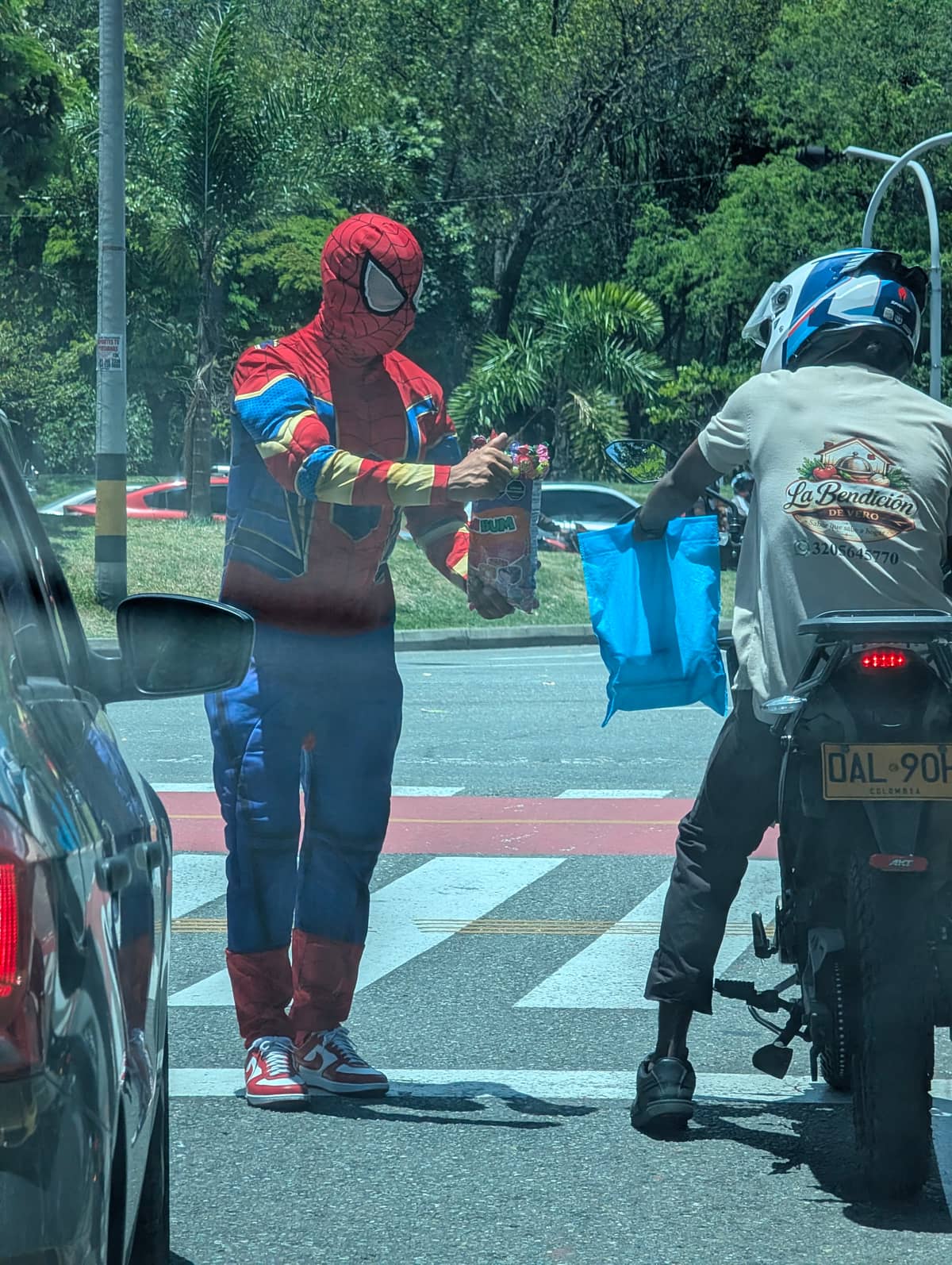
Motorbikes are everywhere and they ride between the lanes. That is not an offence here the way it is at home, it is simply how the traffic works, and a car driver has to assume it on every lane change. The mirror is not enough, turning your head is compulsory.
The horn is not an insult. It means I am here, you cannot see me. It takes about a week to stop flinching.
And then there are the hills. Half the city is built on a slope, the streets are narrow, cars park on both sides of them, and an oncoming vehicle has to fit somewhere. Reversing uphill between parked motorbikes is a skill no driving school teaches.

The numbers that make me uneasy
I work in occupational safety, so this is the part that made me write the article in the first place.
In the first half of 2026, 4,751 people died on Colombian roads. Against the same period of 2025 that is 792 more, an increase of twenty per cent.
How those deaths break down:
- motorcyclists, 65.7 per cent
- pedestrians, 20.6 per cent
- people in cars, 9 per cent
- cyclists, 4.1 per cent
Two thirds of the people who die on the road are on a motorbike. Not because motorcyclists ride worse. Because the motorbike is the cheapest transport there is, whole families ride on one, and between the body and the asphalt there is nothing but a helmet and a t-shirt.
Translated into the language of my day job: this is an exposure you cannot train away. You reduce it by separation, which means infrastructure, and only then by protective equipment.
In practice it leaves me with one rule. I get on a motorbike only with my own helmet and only in daylight. I know that sounds timid in a country where everyone rides one. I also know what is behind those percentages.
What it means for a trip
- On a short trip you do not need a car. The metro, the cable cars and the ride hailing apps cover the city better than a vehicle that has to sit still one day a week.
- If you rent, ask about the plate number at the booking stage, not at the counter. The rental company will tell you the day but cannot change it.
- For up to six months your home licence is enough. An international permit is useful as a translation but is not required. Rental companies ask for one almost every time.
- Budget for tolls. The intercity roads are good and paid for, and you pay cash or with an electronic tag, not by card.
- Avoid driving between towns after dark. It is not about crime, it is about lorries, fog in the passes and cattle on the verge.
- Bring your own helmet if you plan to ride. The borrowed one is usually two sizes too big, and even the right size does nothing unbuckled.
What I still have to learn
I do not have a Colombian licence yet and I am weighing up whether to go through it. Two million pesos and several weeks of appointments is a lot for a document I would need a few times a year for trips.
But having a car would open up places that are on my list and take a full day to reach by bus. When I decide, I will write up how it went, including what they actually test and what is worth practising in advance.
Comments
There are none yet. If you want to ask about something or add to it, go ahead.