Article · Journal · 8 September 2026
El Poblado after dark
- Day of the journey
- 19
- Place
- El Poblado, Medellín
- Reading
- 4 minutes
The district where Medellín was founded in 1616 and where almost everybody who flies into the city now sleeps. Provenza with lights in the trees, the singer Karol G's restaurant, a road sign saying tourist zone, and a bill that sums it all up.
In the afternoon I sat in a café with a laptop and a Czech technical standard on the screen. At six I closed the lid and went out for a walk. Four hours later I ended up four kilometres further south, in a street known to anybody who has read a word about Medellín.
Where the city actually started
There is a mural on a wall by one of the junctions: En el Poblado nació Medellín, Medellín was born in El Poblado. I took it for advertising copy until I looked it up.
On 2 March 1616 the crown magistrate Francisco Herrera Campuzano founded the settlement of San Lorenzo de Aburrá here. It was not a town for Spaniards: it was established under the Laws of the Indies as a settlement for the indigenous people of the valley, who were meant to be protected from how they were being treated. Only on 2 November 1675 was the Villa de Nuestra Señora de la Candelaria de Medellín established further north, which is what people now call the centre.
So yes: the most expensive district in Medellín is also the oldest. What remains of the settlement is the name, a church on a small square, and a sentence on a wall.
Provenza
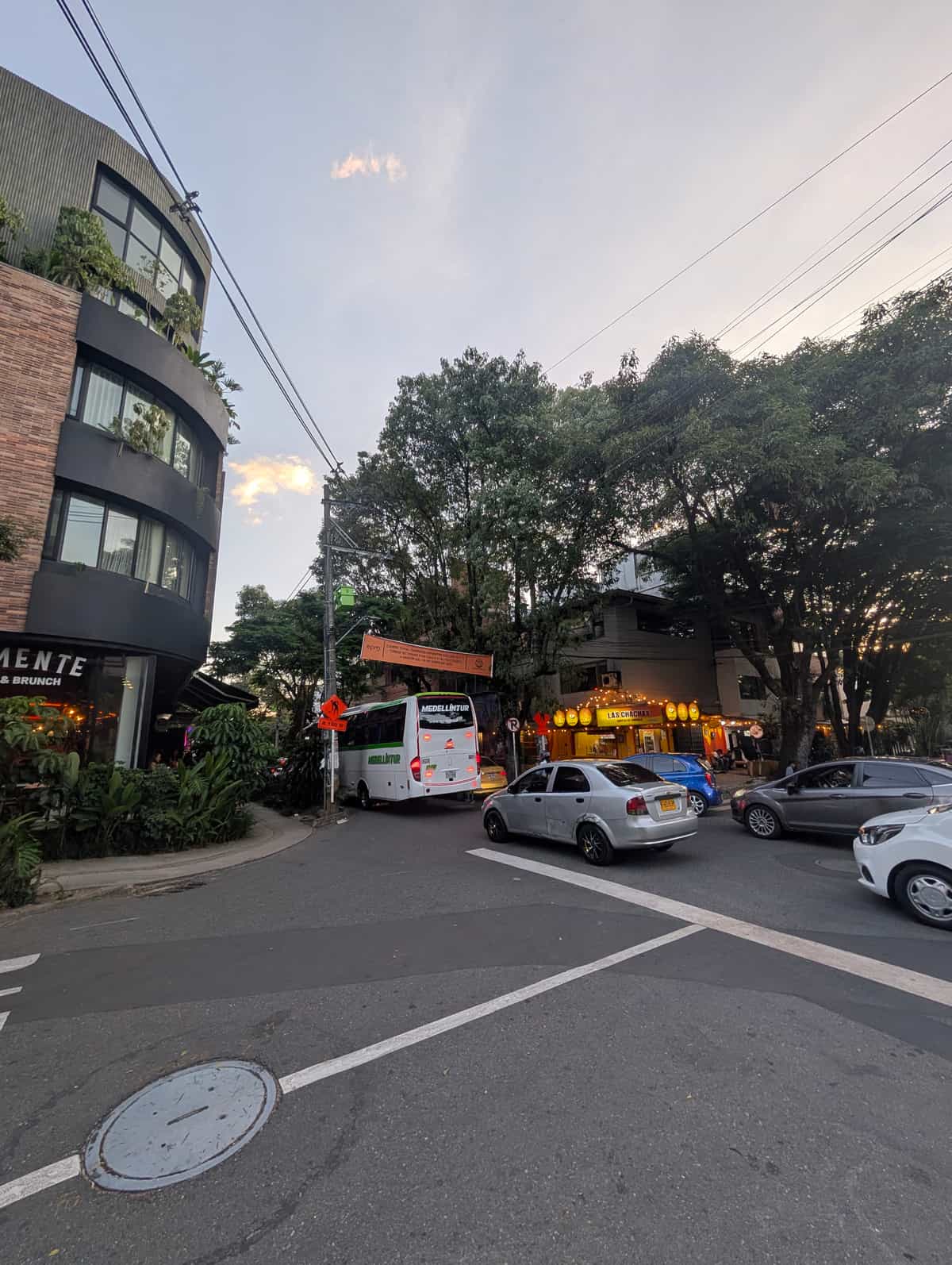
The street people come here for is called Provenza. Until the nineties it was an ordinary middle class residential street, quiet and family sized. From the early 2000s it turned into this: lights in the treetops, twenty venues in a hundred metres, queues, music from both sides, and prices every waiter quotes in dollars in his head.
It is a lovely walk. The trees are enormous, the pavements wide, greenery climbs the facades and bulbs hang overhead. One place has a grove of bamboo growing in the middle of the room, lit green, and it is one of the nicest things I have seen in Medellín.
On a corner stands a white building with a tower and a neon sign reading Provenza. It belongs to the singer Karol G, who opened a restaurant with a rooftop here, a second place next door and a club to go with them; the address is Carrera 35 number 7-33. A short walk away Maluma has a club. Anybody expecting a pop star to open a venue in Bogotá has it wrong: it is done here, within six blocks.
What sits behind it
Medellín received around 1.8 million tourists in 2024 and the vast majority of them sleep in this corner of the city. You can see it in everything.
Rents in El Poblado and Laureles have been rising for years, because a flat earns more on short lets than on long ones, and the people who used to live here are moving further out. Colombian newspapers discuss it under the headings gentrification and airbnbification, and it is a real argument rather than complaining about foreigners: local investors and a shortage of new housing play their part too.
I am part of it, and I have no illusions about that. I live elsewhere and come here to eat, which is exactly the movement of money the argument is about.
A zone with a sign to prove it
One of the streets has a road sign reading Zona turística El Poblado. It looks like a service for visitors and it is also an admission: this part of the city is a product.
I can see it in the prices. A snack and two glasses of wine, one portion of yuca croquettes and two glasses, came to 99,098 pesos including the tip. In Medellín that is what three full meals cost in a place where locals eat.
At the same time: nobody pushed anything on me, the waiter spoke English, the bill arrived electronically with the tax itemised, and the tip was listed as voluntary, which is the law. It is expensive, not dishonest.
A safety officer's eye
A few things I cannot help noticing:
- Cables. Bundles hang over the streets that nobody has counted. Knots, loops, joints wrapped in tape. Nowhere else have I seen so much wiring at that height carried so lightly.
- A bin lorry at ten at night. It drives down a street full of people, two men jogging alongside, one riding on the back. Motorbikes in between. No cone, no banksman, it simply goes.
- Pavements. Wide and new in Provenza. Two blocks away, high kerbs, holes where posts used to be, drains without grates. The difference between the street a visitor sees and the one next to it is half a metre of height.
- The mood. At nine in the evening it is calm, at eleven it is packed. I walked around with a camera in my hand and the only thing anybody offered me was a bar's business card.
What I would advise
Come here, but do not stay here. Or at least not for the whole trip: two days in El Poblado show you what Medellín keeps in its shop window, and a week in Laureles or Conquistadores shows you how the city is lived in.
And if you are going to Provenza, go around eight. At six it is empty, at eleven there is a queue.
Comments
There are none yet. If you want to ask about something or add to it, go ahead.