Article · Journal · 6 September 2026
Up by cable car, down for an arepa
- Day of the journey
- 17
- Place
- Comuna 8, Villa Hermosa, Medellín
- Reading
- 5 minutes
A tram on rubber tyres takes you from the centre to the edge of the city, and a cable car lifts you from there over the roofs of comuna 8. Back down there was an arepa festival, parakeets in a tree, a café in the house by the church, and a concert hall underground.
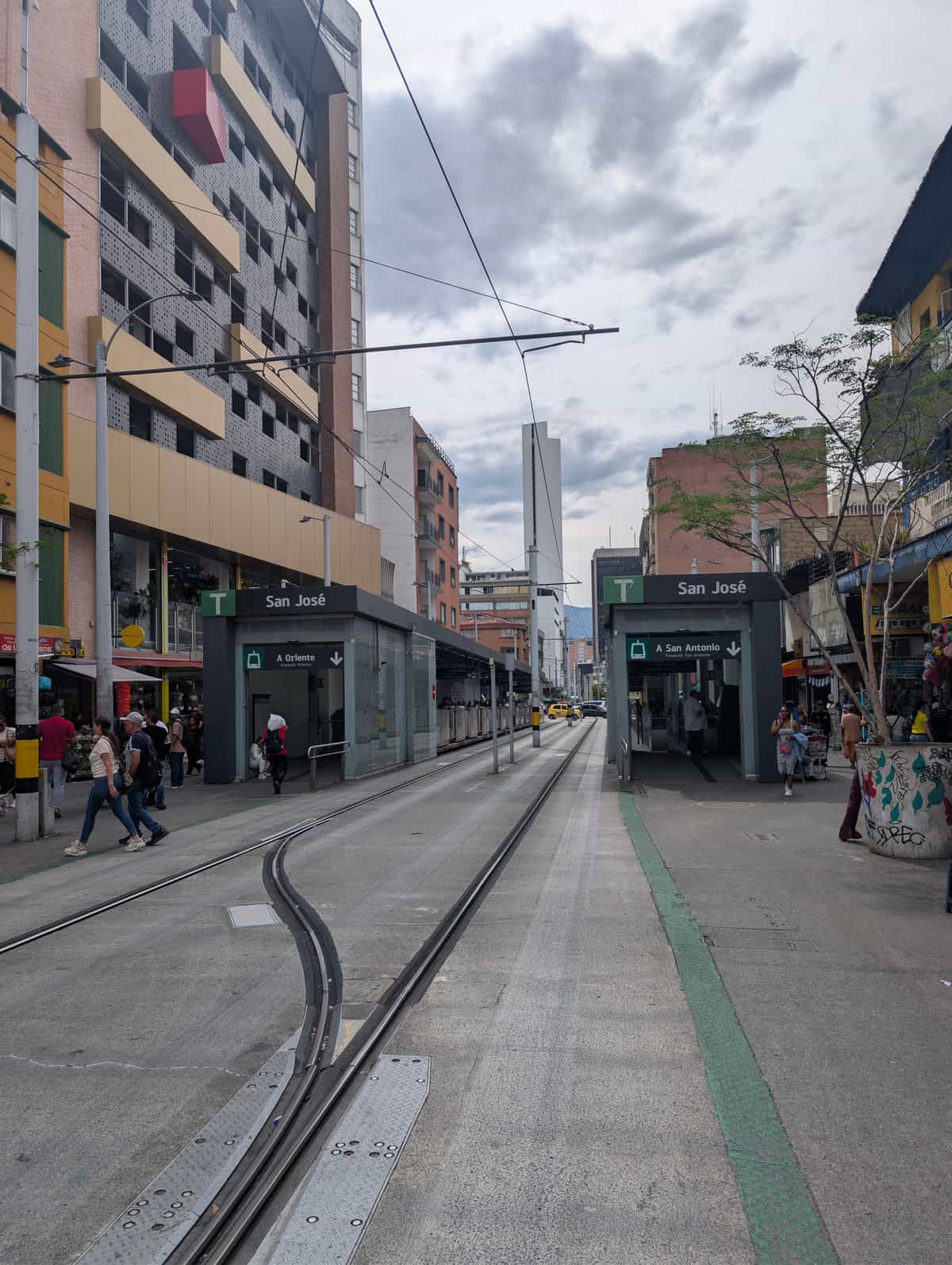
In the afternoon I came across a rail in the middle of a street in the centre, and a vehicle standing on it. It looked like a tram but it ran on rubber tyres. I got on because I wanted to know where it went, and ended up high above the city, at the edge of the slope where the forest starts.
A tram with one rail
The Tranvía de Ayacucho leaves the centre at San José and climbs east along Ayacucho street. It is the only tram in Colombia and it runs on rubber tyres; a single guide rail runs down the middle, the Translohr system, so from a distance it looks like a train and up close like a bus on a rail.
It opened in October 2015. Trams ran along Ayacucho from 1921 until they were scrapped in 1951, so after sixty five years they came back to the same street.
Inside it is calm, air conditioned, full of people riding home with their shopping. The street outside is an ordinary Medellín street: shops, workshops, fruit, motorbikes.
And then it lifts off
At the Oriente terminus you change to the cable car. The transfer is free, the same ticket covers it, you walk through a gate and two minutes later you are hanging in a cabin above the roofs.
Line H has three stations, Oriente, Las Torres and Villa Sierra, and opened in December 2016. Below the cabin comuna 8 unfolds: unrendered brick houses, corrugated roofs, stairs instead of streets, laundry, vegetable patches, a football pitch wedged between buildings, all of it on a slope nobody in my country would build on at all.
You move slowly and it is quiet. It is the closest look a visitor can get at how most of this city actually lives, and nobody has to buy it as an experience.
Why the cable car is there
Comuna 8 is called Villa Hermosa and is one of the poorest and youngest parts of Medellín. It grew from the bottom up without a plan, out of people who came for work or fled violence in the countryside.
The cable car and the tram are a continuation of what they call social urbanism here: put transport, a library, a park and lit staircases into the least accessible neighbourhood and see what happens. A journey that took an hour and a half uphill now takes twenty minutes.
I do not think a cable car solves poverty. But the difference between "an hour and a half on foot" and "twenty minutes for the price of a ticket" is the difference between being able to take a job in the city and not.
Up there
At the last station I got out and just stood for a while. The Medellín valley from up there looks like a bowl full of city: towers in the centre below, slopes covered with houses all the way to the treeline, and mountains above it.
The air is thinner and cooler, the streets quieter, people curious but nobody paid me more attention than is polite. One boy asked where I was from. That was all.
Back down, for an arepa
When I got back to the centre I walked into the Plazuela de San Ignacio and an arepa festival on it. White tents, a band, stalls, and an arepa done differently in each: with cheese, with meat, with egg, sweet, thin, thick, with a sauce of tomato and onion.
An arepa is a corn cake, and in Colombia it is the base of a meal, not a side dish. The festival treats it as heritage rather than as a fair: it is run by the university with Comfama and the Banco de la República, and it is free.
The square is worth it in itself. On one side the San Ignacio church, on the other the Paraninfo, the old seat of the university, and between them an enormous tree that houses a colony of green parakeets. They screech, circle the tower, and nest in holes in the trunk. In the middle of a city of three million.
In the building by the church there is a café, El Bohemio de Clausura: tiles, green walls, ceiling fans, people with laptops, and coffee that woke me up.
La Pascasia
A few steps away stands a building that looks like nothing from outside. Inside is La Pascasia: a café, a bookshop, a gallery, and in the basement a concert hall with a stage where a band was rehearsing.
It is the cultural house of the Música Corriente collective, four floors, a courtyard full of plants, corridors, long tables you can work at. Nobody wants anything from you.
Of all the things I did not expect in the centre I had been warned about, this was the least expected.
Walking home
It is an hour on foot from the centre to Conquistadores. I went through the Parque de las Luces, a plaza with three hundred concrete poles that light up after dark.
The Guayaquil market stood here for a century, the trading heart of the whole region, and when it moved out in the nineties the square became the worst address in Medellín. In 2003 the architect Juan Manuel Peláez won the competition to transform it with a design whose motto was that Medellín is light. There are three hundred poles and the tallest are twenty four metres. It opened in 2005.
Then I walked in the dark along a pavement beside a big avenue, a river of lights beside me and mountains above. Not once was I afraid. I got home late and my legs knew about it.
In one day: metro, tram, cable car, palace, museum, cathedral, market, festival, concert hall and an hour of walking at night. Transport cost me a couple of euros.
Comments
There are none yet. If you want to ask about something or add to it, go ahead.