Article · Journal · 31 August 2026
Where I live: Conquistadores
- Day of the journey
- 11
- Place
- Conquistadores, Medellín
- Altitude
- 1495 m
- Reading
- 7 minutes
A neighbourhood between the river and Laureles that nobody writes about. Dogs on every corner and clean pavements, greenery that is not an accident, a bridge to the Barefoot Park, and seventies buildings among the palms.
When I arrived, I had no idea I would end up choosing a neighbourhood nobody writes about. A few weeks in, I know it was the best accident of the whole move.
It is called Conquistadores, officially barrio 1105 in comuna 11, Laureles-Estadio. It sits in a wedge between Avenida Bolivariana, the Medellín river and Avenida 33. Tourists do not come here, because there is nothing to tick off. People live here.
The morning starts with dogs
The first thing anybody notices here is the number of dogs. Not two on the street, but a continuous stream: big ones, small ones, old ones, in harnesses, in carriers, in pairs, on long leads. And with them the people walking them, from six in the morning until ten at night.
And here comes the part my Czech head could not process: there is nothing on the pavements. No mess, no bags dumped next to a bin, nothing. People clean up after their dogs without anybody watching.
Beyond making the walking pleasant, it says something about the neighbourhood. A street somebody is walking along from morning to night is a street where somebody is always looking. That is the cheapest and most effective security measure a city can have.
The greenery is not an accident
Palms between the buildings, trees in the streets, balconies so overgrown that in places you cannot tell where the railing ends and the garden begins. Arriving from Europe, you want to credit the climate.
Except part of it is work. Since 2016 Medellín has been building green corridors, strips of trees and plants along its avenues and streams. Nearly 880,000 trees and two and a half million smaller plants went in; in the planted corridors the average air temperature fell from 31.6 to 27.1 degrees and surface temperatures by more than ten degrees. Over a hundred gardeners from poorer neighbourhoods were trained in the process.
That is not decoration, that is air conditioning for an entire city. And you can walk through it.
A bridge, a park and a sculpture worth standing in front of
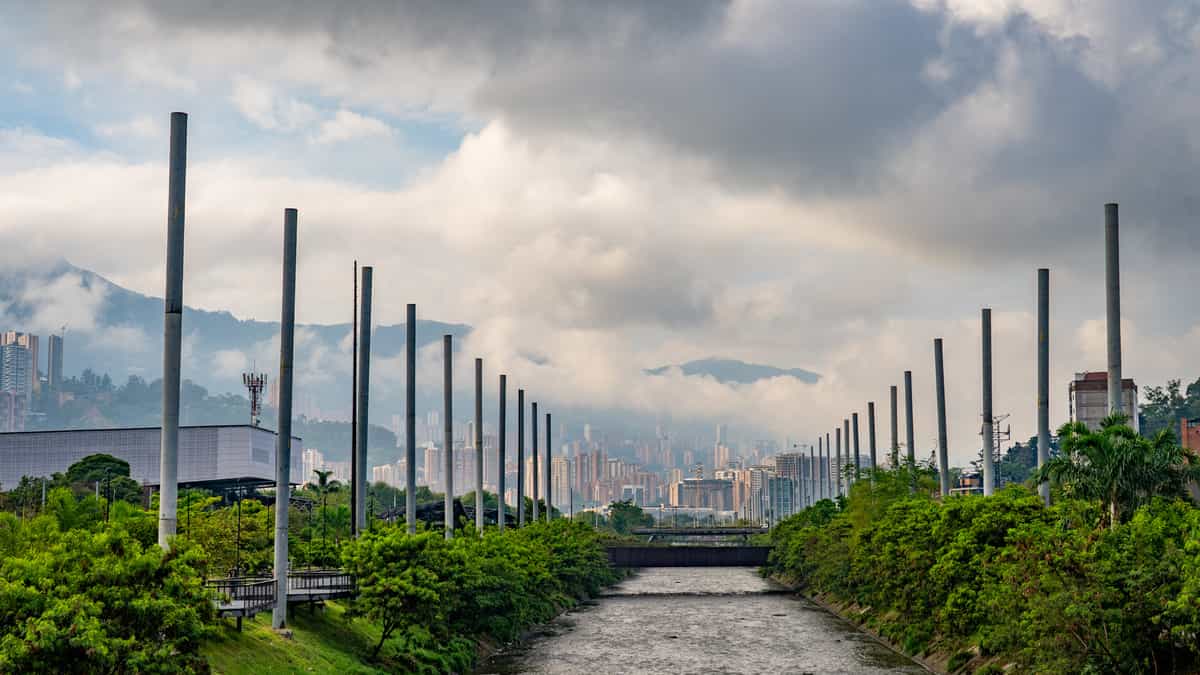
The river runs close by and a bridge crosses it. On the other side is the Barefoot Park, areas of sand, water and bamboo you genuinely walk on barefoot, and above it the glass EPM building with water all around it.
Along the river runs Parques del Río, a park built over the traffic, and the whole area has sculptures I have got into the habit of going to look at. It is not a museum, it is a city that took care.
And on Sundays the farmers markets open in the parks. White tents, fruit, vegetables, cheeses, bread, flowers. Not markets for visitors: the people there are neighbours with dogs and shopping bags.
The architecture I noticed only after a week
Much of Conquistadores was built in the sixties and seventies, and it shows. Brick, simple volumes, long balconies, a building conceived as a whole rather than as a stack of flats. Among them a few new towers that either adapted to it or stick out, depending on who built them.
In Medellín, comuna 11 is talked about as architectural heritage worth protecting, and after three streets you see why. It is not beautiful the way a historic centre is. It is beautiful the way a city is when somebody thought it through and then looked after it for forty years.
Where the neighbourhood came from
Medellín grew on one side of the river for a long time. The western bank was the edge of town: railway, warehouses, industry. Comuna 11 was built in the middle of the twentieth century as a planned expansion onto this side, and you can still see it.
Neighbouring Laureles has a radial plan from the late forties, ring streets instead of a grid, usually attributed to the painter and architect Pedro Nel Gómez. Conquistadores came out of the same wave, with more regular blocks and with the river at the end of it.
And the river is what has changed most in the past ten years. It used to be a traffic edge the city turned its back on. In 2016 Parques del Río opened, a park laid over the traffic, and the boundary became a destination. Since then people come here to run, to walk dogs and to sit. Living by the river in Medellín means something different now than it did twenty years ago.
A day in the neighbourhood
Six in the morning. Dogs, runners and people heading to work. The air is fifteen degrees and it is the only part of the day when Medellín is cold.
Ten. The streets empty, the cafés open, the corner shops get going. The best time to work by a window.
One in the afternoon. Menú del día in the places around, every one of them full. Lunch happens at the same hour as at home, only without the hurry.
Four. In the wet season the rain arrives, drops everything it has in twenty minutes and is gone. People shelter under awnings and wait, because that is quicker than running.
Seven in the evening. Bars on the corners, neighbours outside their buildings, dogs for the second time. And across the river the city lights up.
Where you shop and where you sit
Everything is walkable. A shopping centre with an Éxito supermarket, corner shops, a D1 for the cheap basics, a market hall, pharmacies, repair shops. Cafés you can sit in with a laptop, and bars where after six the people are from around here.
There are no foreigner prices, because there are no foreigners. That is the best thing about it.
The Pontificia Bolivariana campus is nearby, so a good share of the residents are students. You can feel it: cheaper lunches, more cafés, and evenings livelier than that list suggests.
Safe, and not a stage set
I feel safe here. I go out in the evening, I carry a backpack, I do nothing special and I have never had a problem.
At the same time I would be lying if I wrote that it is polished. There are people living on the streets. Sleeping on pavements, against walls, under awnings. Nobody clears them away and nobody behaves oddly around them: they are part of the city the way they are part of every large city in the world.
It keeps interesting me professionally. For fifteen years I have walked through places where something is going on, noticing things nobody notices because they are always there. This is one of them, and it has no easy answer here or at home. I am not writing it as a warning about the neighbourhood; I am writing it because without it the picture would not be true.
What applies here applies everywhere: no dar papaya. Phone in the pocket, not in the hand, get dropped at the door at night, pay attention on the big avenues. The rest is ordinary life.
What I have to watch
Noise from the avenues. Avenida 33 and San Juan are big and a flat facing them knows it. A flat facing into the block is a different world.
The metro is not around the corner. Either across the bridge to line A or a walk northwest to line B. Ten to fifteen minutes, which is fine until it rains.
Crossings. A Colombian driver has personal views about red lights and a pedestrian is on their own. I have written about the traffic elsewhere, and in Conquistadores it applies at every big junction.
Why I would choose it again
Conquistadores is exactly the band between El Poblado and Laureles I describe in the Medellín guide: the quiet of a residential neighbourhood while still being in the city. The centre across the bridge, the bars on Avenida 70, greenery down by the river, a shop around the corner.
If somebody asked me where to live in Medellín, I would say Laureles or this. And after two weeks here I think this is the better half of the answer.
Comments
There are none yet. If you want to ask about something or add to it, go ahead.