Article · Worth knowing · 10 September 2026
The bin men of Medellín
- Day of the journey
- 21
- Place
- Conquistadores, Medellín
- Altitude
- 1495 m
- Reading
- 8 minutes
A garbage truck with a slogan saying this city is a little silver cup. Who runs it, where the waste goes, why the landfill has eight years left, and how the people who open bags on the street come to be paid out of the water bill.
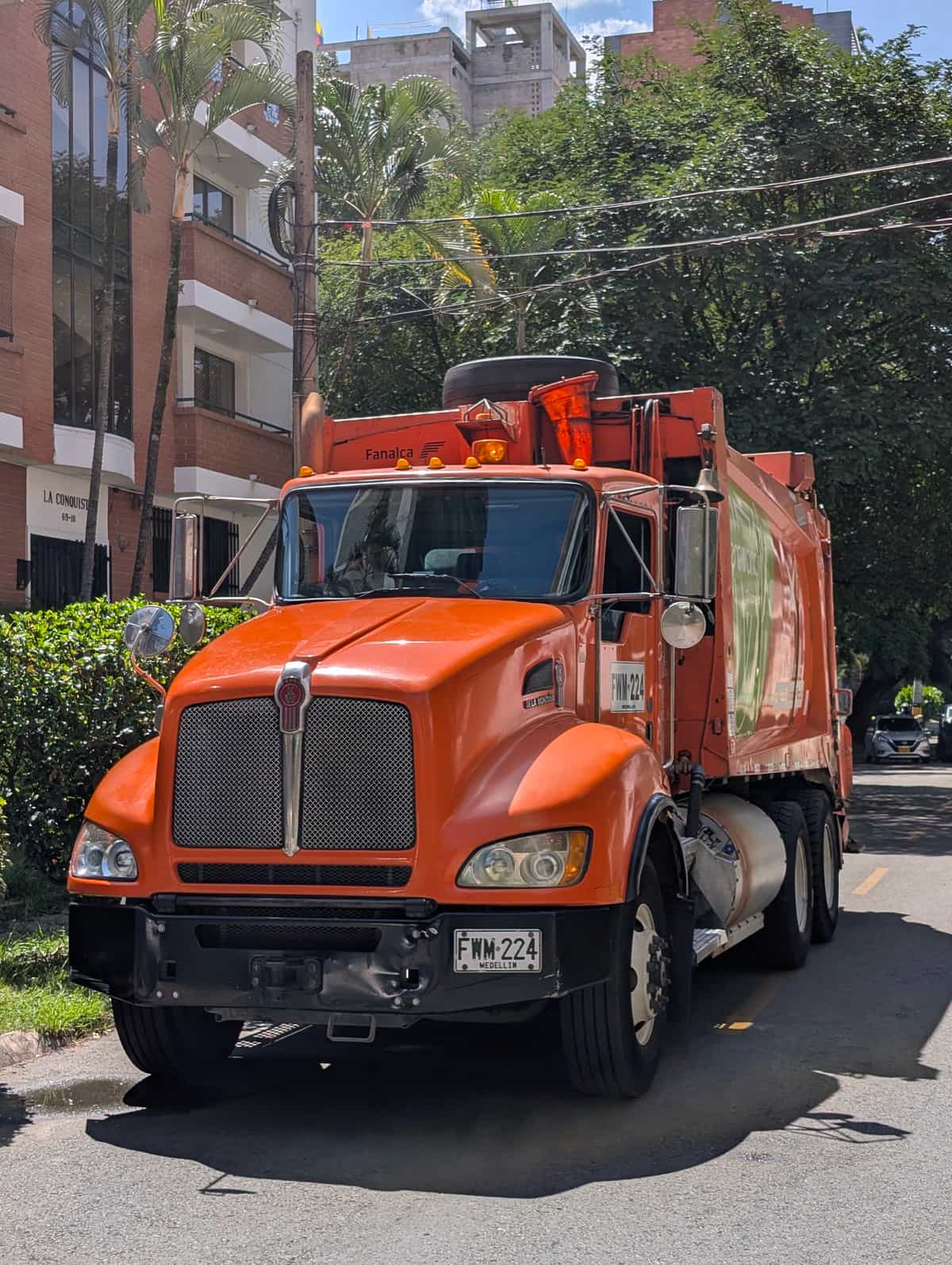
On Thursday morning I went out for coffee and a garbage truck stopped me. Not by blocking my way: by how it looked.
White and green, clean, with a slogan running the whole length of its side. "A tu lado brilla nuestra Tacita de Plata." At your side, our little silver cup shines. Back home I never once looked at a garbage truck as a thing worth looking at. Here I photographed it from four angles.
Tacita de Plata, the little silver cup, is Medellín's nickname from the second half of the last century. The city earned it for the cleanliness of its streets and parks, and for sitting in a valley like something held in a bowl. Painting that sentence on a garbage truck is cheek and manifesto at once: the vehicle that hauls away the mess drives around under a line about how clean this city is.
What the truck is
A Kenworth chassis, a body by the Colombian firm Fanalca, a compactor made of Hardox wear plate. Fleet number 629, plate FWM 224, Medellín. The operator is Emvarias, a city company inside the EPM group, meaning the same utility that supplies the city with electricity, water and gas.
That is the first difference from home. Waste collection here is not a contract tendered out to a private firm every four years, it is a public service run by one municipal group, and you can see it. The trucks are identical, clean and new.
The whole fleet was in fact replaced at once. To introduce a third collection day, Emvarias took delivery of fifty seven new trucks, which on two shifts can handle more than 1,300 tonnes a day, run on natural gas and meet Euro VI. At the end of 2025 another fifteen collection trucks, six small loaders and two street sweepers joined them.
A gas powered garbage truck in the middle of the city, one that does not smoke and is quieter than a diesel, is not a detail. Medellín sits in a narrow valley where the air has nowhere to go during the day, and air quality is the local public issue number one.
How much the city produces
Medellín collects roughly 2,500 tonnes of waste a day from sixteen comunas and five rural corregimientos. Households alone account for about 1,110 tonnes of that.
The composition is the interesting part. Of what households throw out, 13.2 percent, some 146 tonnes a day, is recyclable material, and 56.6 percent, roughly 628 tonnes a day, is organic. Together that is seventy percent which does not have to end up in a landfill, and which largely ends up there anyway.
That number is the whole story of waste management in one sentence, and it holds almost everywhere in the world. The problem is not that the waste cannot be used. The problem is that it does not get separated at the moment it is created.
Where it goes
The landfill is called La Pradera and sits in the municipality of Donmatías, about 57 kilometres north of Medellín. It opened on 6 June 2003, covers 382 hectares and takes waste from Medellín and more than thirty seven other municipalities in Antioquia. More than 3,500 tonnes arrive there every day.
Emvarias runs it too. Landfill gas is captured and burned in two flares, so the methane comes out as carbon dioxide, which in greenhouse terms is a considerably better trade. The leachate is treated by ultrafiltration.
Capacity was a serious problem. The site was running out of room and the permit for a new cell dragged on for years. The cell named La Piñuela finally opened on 17 September 2025 and extended the landfill's life by roughly eight years.
Eight years. For the waste system of a city of two and a half million people that is a very short horizon, and it is exactly why the city pushes separation the way it does.
How separation works here
Since 1 January 2021 Colombia has had a single colour code for the whole country, introduced by environment ministry resolution 2184 of 2019. Three colours, not ten.
White is for what can be recovered: paper, cardboard, glass, metals, clean plastics. Green is for organics, meaning food scraps and anything that rots. Black is for the rest, the part that cannot be recovered: used tissues, napkins, metallised paper, food stained cardboard.
Three bags instead of five bins is a system built for a city where a large share of people live in flats and have nowhere to line up a row of containers. Here waste does not go into a container on the corner, it goes out in front of the building in a bag, at the hour the truck comes.
And there are hours for it. Waste may be put out no earlier than three hours before collection, no sooner, because otherwise the bags get torn open overnight by dogs and by people looking for material. The schedule runs by barrio and comuna, you look it up on a map on the Emvarias website, and it changes: from June 2026 the times shifted in comunas 1 to 7, that is Popular, Santa Cruz, Manrique, Aranjuez, Castilla, Doce de Octubre and Robledo. In some places collection is Monday and Thursday between seven and nine in the evening, elsewhere the same days but between one and three in the afternoon.
It sounds like a small thing until you picture what it means. You have to know when a truck passes your specific door, and you have to be home at that time or have an arrangement with the porter. In a building with a porter's desk, which is standard at the better addresses here, the porter deals with it. Whoever lives alone in a single storey house up the hill deals with it alone.
Ruta Recicla and the people who pick
Alongside the ordinary collection, a separate route for recoverable material has been running since 2017. It is called Ruta Recicla and it does not cover the whole city: it runs in Belén, La Floresta, Laureles, the centre and El Poblado. In residential zones once a week between six in the morning and two in the afternoon, in El Poblado's bar district Monday to Saturday at night between nine in the evening and five in the morning, because that is when the waste there is produced.
They take paper, glass, plastics, cardboard and clean drink and food cans.
The other half of the system is not trucks but people. Recuperador de oficio, literally a picker by trade, is an official occupation here. The city counts 4,782 of these people in 24 organisations. They walk the streets with a hand cart, open the bags and take what has value.
Up to that point it is a picture familiar to anyone who has been to Latin America. What is interesting is what the state did with it.
The Constitutional Court ruled that these people perform a public service and ordered the government to set up payment for it. Since July 2017 utility bills in Medellín therefore carry a separate recovery charge, and the money goes to picker organisations registered with the public service providers' registry. The rate is calculated as the collection and haulage cost plus the disposal cost in the municipality where the picking happens. The first to be paid were the RECIMED cooperative, with around seven hundred and fifty members, and ARRECICLAR. By 2018 thirteen cooperatives were receiving it.
I know of no European equivalent where informal pickers are paid out of a public tariff for what they divert from a landfill. We can argue about whether it is enough money. But it is a system that acknowledged an existing reality and wired it into the financing, instead of banning it.
A safety guy's eye
I did not see the crew working, I saw an empty truck on the street, so this is a reflection rather than an inspection.
But waste collection ranks worldwide among the most dangerous occupations there are, regardless of country. The hazards are always the same: movement around a reversing vehicle, street traffic while the truck stands as an obstacle, manual handling of a load of unknown weight and unknown contents, sharps inside the bag, biological risk, noise, and on a compactor body a machine with enough force to crush waste.
A bags on the pavement system like this one makes some of those worse and others better. It makes manual handling worse: the bag has to be lifted off the ground rather than tipped out of a bin, and nobody knows what is inside. It improves the thing crews back home struggle with most, which is dragging heavy bins over kerbs and broken surfaces.
What struck me practically: the trucks are new. A new truck means a working reversing camera, working lights, boarding steps in good order and a compactor emergency stop that actually stops. Replacing a fleet in one go is an intervention in occupational safety, even when it is sold as an environmental measure and even when nobody calls it that.
Why I am writing about this at all
Because it is a thing I never look at back home.
In the Czech Republic I know the bin gets emptied on Wednesday and my interest ends there. Here, in the course of one morning, I learned that the city has eight years to work out where it will take its waste, that seventy percent of what people throw out does not have to go there, and that the people who narrow that gap with their own hands get paid out of a line on the water bill.
And that a garbage truck can have it written on its side that the city it drives around in is a little silver cup.
Comments
There are none yet. If you want to ask about something or add to it, go ahead.