Article · Journal · 6 September 2026
El centro: the day I finally saw the city
- Day of the journey
- 17
- Place
- La Candelaria, Medellín
- Altitude
- 1495 m
- Reading
- 7 minutes
Every second person told me not to go into the centre of Medellín. I went by metro, cleaner than the one at home, and found a palace with a chequerboard facade, twenty three Botero sculptures, a cathedral made of a million bricks, and a market that has run since the seventies.
I have been living in Medellín for a few weeks and I knew three neighbourhoods: my own, El Poblado and Laureles. Every second person told me not to go into the centre, and if I did, not with a camera, not after dark, and preferably not at all.
On Saturday morning I got on the metro and went to look. I came back at night on foot across half the city, and it is the best day I have had here so far.
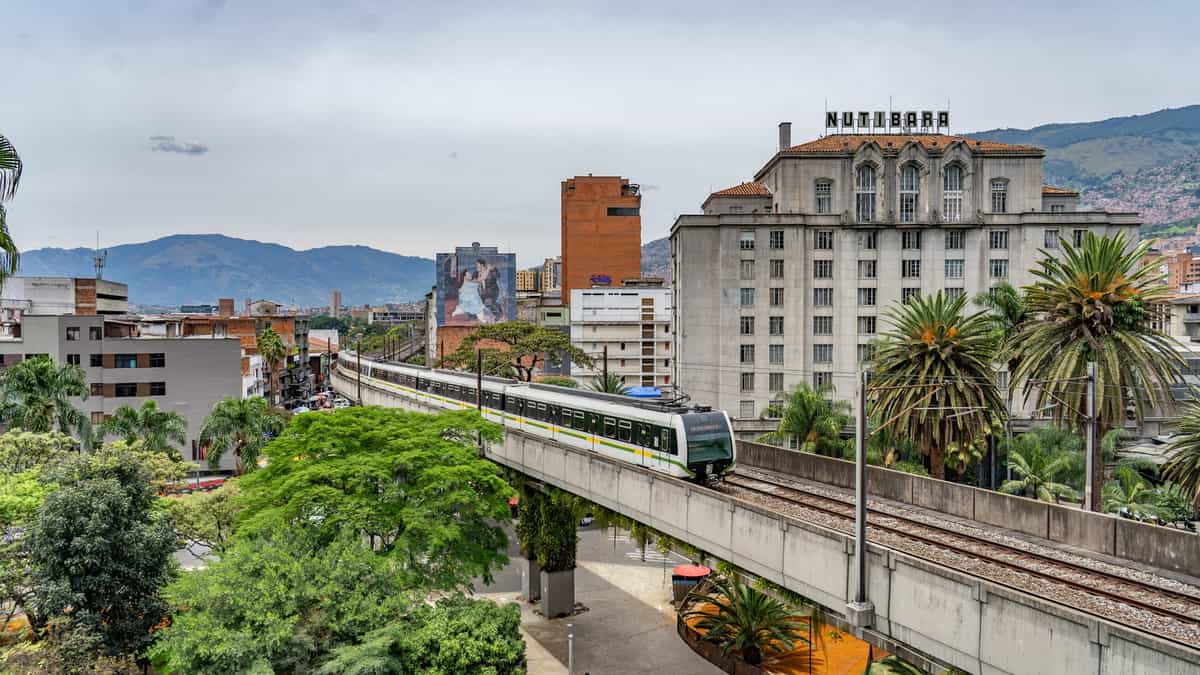
The metro is the city's calling card
The train arrived clean, air conditioned and on time. Nobody ate in the carriage, nobody shouted, nobody sat on the floor. The stations have railings, signage, and staff who point you the right way.
The Medellín metro has run since 1995 and is still the only one in Colombia. In this city it is not transport, it is a symbol. People talk about the "metro culture", and you can tell it is enforced: outside marked areas nobody eats or drinks anywhere in the system, and nobody finds that strange.
The line crosses the centre on a viaduct, so before you get off you ride through the district at second floor height. Under the bridge, where I expected dirt and gloom, somebody built a space: paving, benches, stalls, passages. It is not pretty like a park, but it is alive and clean.
A needle over the city
The Edificio Coltejer rises above the centre. A skyscraper that narrows at the top into a point, so that it looks like a needle stuck into the city.
That is exactly the idea. It was built by the textile company Coltejer, the Compañía Colombiana de Tejidos, and the point is meant to recall a needle from a loom. Construction ran from 1968 to 1972, the tower is about 175 metres and thirty six floors, and for several years after it was finished it was the tallest building in Latin America.
In Medellín that tower is a landmark. Anybody who gets lost finds it above the roofs and knows where the centre is.
The palace everybody takes for a church
In the middle of the centre stands a building I could not place. A chequerboard of black and white, domes, turrets, something between a castle and a cathedral.
It is the Palacio de la Cultura Rafael Uribe Uribe. Construction began in 1920 on the orders of governor Pedro Nel Ospina, and the design came from the Belgian architect Agustín Goovaerts, whom Antioquia brought over from Europe to build its public buildings. It was only finished in 1937, and the province was governed from here until the late 1980s.
The chequered render is so unusual that for years locals crossed themselves as they walked past, because they took it for a church. I understand them.
Entry is free. You show a document at the door, your name goes in the book, and that is it. Inside there are two courtyards, one octagonal with a palm in the middle, staircases, colonnaded corridors, exhibitions, and from the upper floor a view over the Plaza Botero.
In the hall stood a silleta, one of those huge flower pictures carried on the back in the August parade, with a sign saying that culture is in bloom in the palace. I let myself be told.
Twenty three fat bronzes
In front of the palace is a square, and on it sculptures everybody recognises without knowing where from: round women, round men, round animals, all black and polished where people touch them.
Plaza Botero was created in 2001 and holds twenty three sculptures by Fernando Botero, given to the city by the artist himself. Botero was born in Medellín and gave the city a collection of paintings as well as the bronzes.
On the other side of the square is the Museo de Antioquia, a museum founded back in 1881 that moved into the former municipal palace in 2000. It has a Botero room, modern Colombian art, and a café inside that I did not want to leave.
Otherwise the square is full of people photographing themselves with the sculptures, of vendors, music and children. It is not an open air museum, it is a square that happens to have tens of millions worth of sculpture on it.
A cathedral made of a million bricks
A few blocks away is Parque Bolívar, and on its northern side a cathedral whose figures I had to check twice.
It was built between 1875 and 1931 to a design by the French architect Charles Émile Carré, and roughly 1,120,000 fired bricks went into it. It is usually described as the largest fired brick building in the world. The towers are sixty six metres high, and it has been a national monument since 1982.
From outside it looks almost sober. The numbers only land when you stand at the wall and see brick on brick going up fifteen metres without a single piece of stone.
A market more than fifty years old
I was lucky enough to arrive on the first Saturday of the month. On that day the park around the cathedral and the little square by the university church turn into the Mercado de San Alejo: hundreds of stalls of craftwork, paintings, jewellery, leather, coffee, food.
The market started spontaneously in the early seventies and it is still going, once a month, with hundreds of sellers. You walk through it slowly, because something is happening everywhere: playing, dancing, selling, eating.
A short way off a man sits on the pavement drawing the Virgin of Guadalupe in pastel straight onto the paving. A ring of people around him. In an hour they will be walking over her.
Streets full of hatching
You cannot switch off a safety officer's eye. The first thing I noticed in the streets was the road marking: enormous yellow hatching, blocks, wedges, whole surfaces that guide pedestrians and tell drivers where to slow down.
It looks like graphic design and it is a control measure. A crossing here is not two lines, it is an area you cannot miss.
The second thing: stalls. Fruit, juice, corn, phones, socks, headphones, keys. Many thousands of people are estimated to work on the street in the centre. It is loud, chaotic and nobody pushes.
And the third thing, which I would not have understood without walking it: there is always somebody in the centre. Not a crowd in six streets and emptiness next to them, but people everywhere. Nothing happens to you on a full street.
Versalles
On the Junín pedestrian street stands Salón Versalles, opened in 1961. An Argentine, Leonardo Nieto, founded it as a corner of Buenos Aires in Medellín, and almost nothing has changed in it since. Borges came here. The empanadas are still made the same way.
The eighties, when nobody wanted to come into the centre, passed over it and it stayed open. That is the main thing about it.
And what about safety
I walked around the centre from midday until evening with a camera over my shoulder, and nothing whatsoever happened.
I do not want to turn that into a rule. The rule is still no dar papaya, do not hand anybody an opportunity: no phone in your hand, no camera hanging off your back, take a car after dark, leave the centre at night for another time. But the fear half this city feels about the centre is twenty years older than what I saw.
The strongest impression of the day: this is a normal big city. Busy, poorer than the districts around it, with homeless people on the pavements and police on the corners. And also with free museums, a metro you could eat off, and a market that has worked for fifty years.
Anybody who comes to Medellín and spends a week in El Poblado has seen shopping malls. The city is here.
Comments
There are none yet. If you want to ask about something or add to it, go ahead.