Article · Journal · 2 September 2026
Laureles: a neighbourhood drawn in circles
- Day of the journey
- 13
- Place
- Laureles, Medellín
- Altitude
- 1495 m
- Reading
- 3 minutes
A garden city from 1940 with circular streets, fig trees across the whole road, and cafés you can work from. The neighbourhood Medellín recommends to itself, and the one Time Out called the best in the world.
Ask anybody in Medellín where to live and you get two answers. El Poblado, if you ask a tourist, and Laureles, if you ask somebody who lives here.
I spent three days in a row in Laureles: walking, working from a café, having lunch in a place for locals. I am writing this as somebody who lives one neighbourhood away and comes here because it is pleasant.
A neighbourhood drawn in circles
Laureles is the only part of Medellín where I reliably get lost, and that is by design.
It was laid out around 1940 as a garden city: wide avenues, lines of trees, parks, low buildings, and above all circular streets, the circulares, that wind around what was then the new Pontifical Bolivarian University. The rest of the city is a grid; this is a set of circles. The plan is attributed to the painter and architect Pedro Nel Gómez.
The consequence: addresses here do not work as they do elsewhere. Instead of a carrera and a calle you get Circular 1, Circular 2 and a Transversal, the streets curve, and two junctions in a row look identical. A map on your phone is more useful here than in the centre.
Comuna 11 is called Laureles-Estadio, because the stadium belongs to it too.
Trees
The trees are what brings me here.
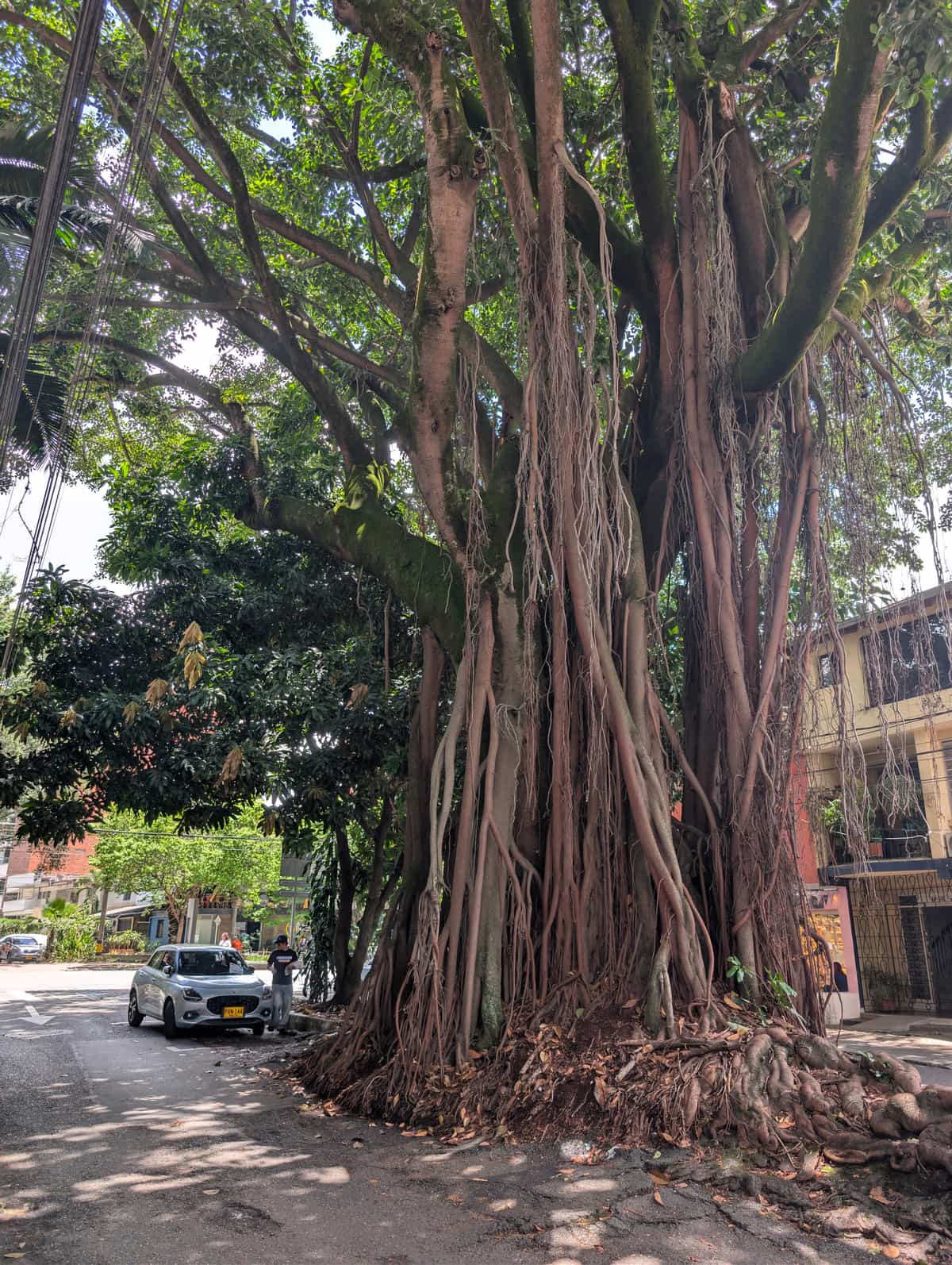
Several streets have fig trees with trunks wider than a car and roots that have broken through the pavement and kept going. The crown reaches across the whole street and at midday it is five degrees cooler underneath. Then palms, mango trees, and trees whose names I do not know, covered in flowers.
A garden city from 1940 now looks like a forest somebody put four storey buildings into.
Life without tourists
There are no hostels in Laureles, no groups with a guide, and nobody speaks English to you in the street unless you start.
What there is: bakeries with a queue at six in the morning, cafés that roast their own coffee, bars where people watch football, markets, stationers, shoe repairs. The pavements are full of people going home from work, not taking photographs.
I worked from several cafés here and all of them tolerated four hours with a laptop, a coffee and one extra order. The wifi works, there are sockets, nobody stares.
In 2023 the British magazine Time Out named Laureles the coolest neighbourhood in the world. That brought what such awards bring: more foreigners, higher rents, and complaints from people who have lived here all along. For now it is still a neighbourhood where people live rather than one that gets looked at.
What I ate here
Menú del día in a place where the neighbourhood eats lunch: soup, a main course, juice, dessert. Fish in a cream sauce that would pass in Europe. Cactus lemonade. Matcha, because even here there is a place that makes it better than in Prague.
Then I sat on a bench in front of the Santa Teresita church, a brick building with a high nave and coloured windows, and watched people walk past for half an hour.
Why I do not live here
I live in Conquistadores, a few streets away, and that is how it worked out. If I were moving again, I would be choosing between these two, and it would come down to whether I want to be closer to the river and the centre or in among the trees.
Laureles is the answer to the question of whether you can live normally in Medellín. You can.
Comments
There are none yet. If you want to ask about something or add to it, go ahead.