Article · Journal · 7 September 2026
Guatapé: painted houses and a village under the water
- Day of the journey
- 18
- Place
- Guatapé
- Altitude
- 1925 m
- Reading
- 3 minutes
A town where people have spent a century painting their trades onto their walls, and a lake that came into being when a dam drowned the town next door. An afternoon on a boat puts the two together.
From the rock we drove to Guatapé, a small town on the shore of the same reservoir a few kilometres away. It is a picture postcard place, and I mean that both as praise and as a reservation.
Painted houses
Guatapé is famous for its zócalos. A zócalo is a band along the bottom of a wall, meant to protect the render from damp and livestock, and here it turned into art.
Around 1920 a local man, José María Parra Jiménez, painted sheep onto his. The neighbours joined in and began painting what they did for a living: bread for the baker, pots for the potter, a cow for the farmer. Then flowers, birds, guitars, indigenous patterns.
Today the whole town has them, and with them facades in colours you do not get used to: turquoise next to yellow, pink next to blue, and none of it jars. It is the work of several generations, not a whim.
Square, streets, umbrellas
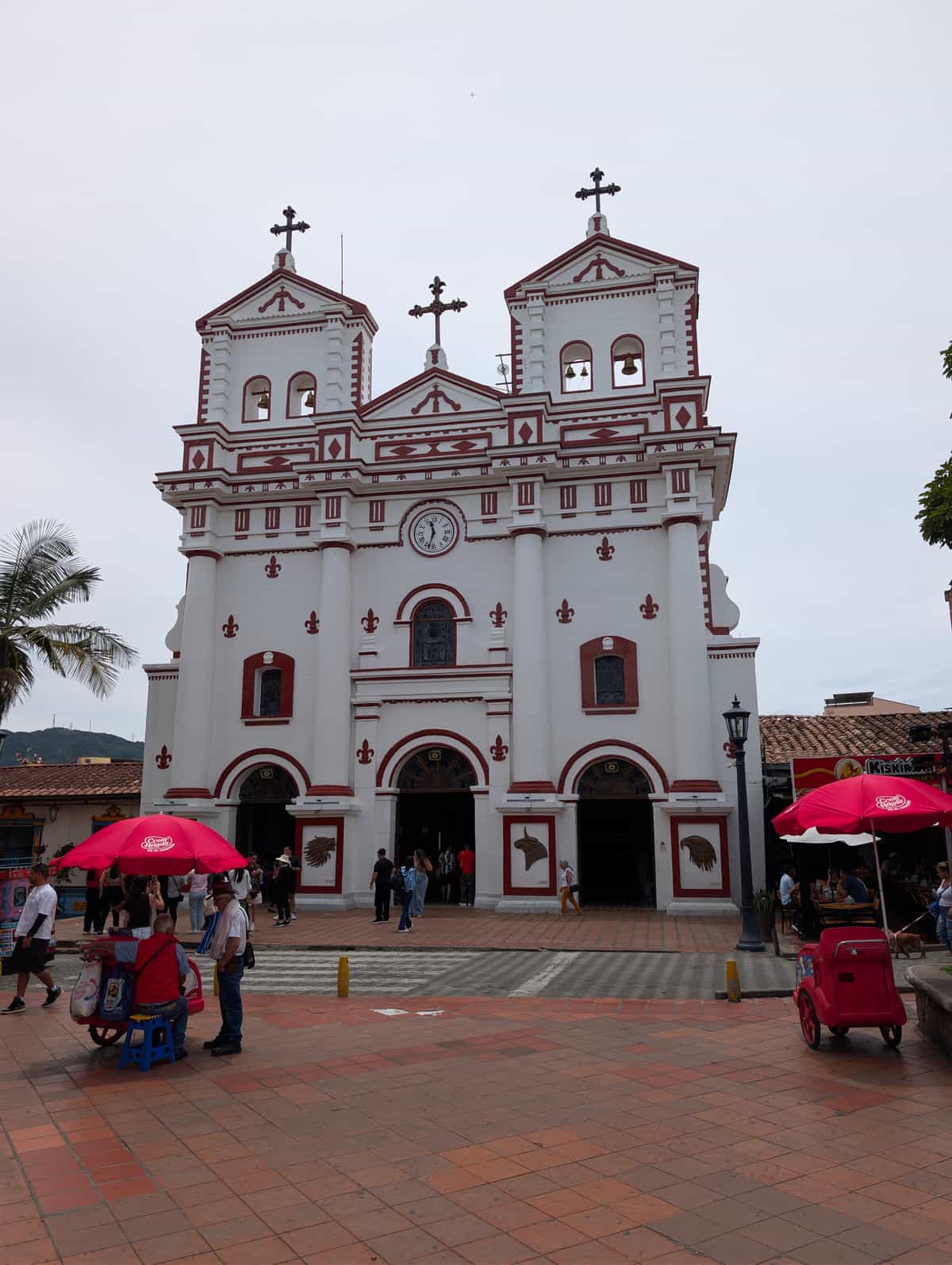
On the main square stands a white church with red edges and two towers, a wooden ceiling and pews inside. In front of it a fountain, benches and vendors.
The Calle del Recuerdo is a street with hundreds of coloured umbrellas hanging over it. It looks great in a photograph and there is a queue for it, because everybody knows.
The best streets are the ordinary ones two blocks further on: cobbles, cypresses, balconies, a cat on a wall, two men in front of a workshop. Nobody is there.
What lies underneath
Until the 1970s Guatapé was a farming town and the lake did not exist.
Empresas Públicas de Medellín built a dam here and started filling the reservoir in 1970; it was finished in 1979. The water covered fields, farms and the whole town of El Peñol, which had to be rebuilt somewhere else. Thousands of people moved, the church stayed under the surface, and when the water is low a cross still rises from the spot where the altar stood.
It is the largest regulating reservoir in Colombia and its power stations still feed the country. The tourism Guatapé lives on sits on the bottom of that story.
It sounds like a line from a guide. I could not get it out of my head: you stand on the promenade with boats and music around you, and under that water there is a square.
The boat
In the afternoon we took a boat out. That is the part of the day I would do again.
The lake is huge and ragged, the peninsulas and islands look from above like spilled green, and between them move boats, floating houses and one jet ski making noise for all of them. The boat rounded the inlets and finally turned towards the point where the rock we had stood on that morning rises above the water.
That is the view I took away from here: two hundred metres of stone, a green shore, and between them water with a village under it.
Whether to go
Go, but not on a Saturday afternoon and not for two hours.
The rock in the morning, the streets late morning, lunch by the water, a boat in the afternoon. Anybody who comes on a day trip walks the umbrella street, buys a magnet and leaves thinking Guatapé is pretty and crowded. Both are true and both are not enough.
Comments
There are none yet. If you want to ask about something or add to it, go ahead.